
By Robert Parry
June 20, 2007
In years to come, historians may look back on U.S. press coverage of George W. Bush’s presidency and wonder why there was not a single front-page story announcing one of the most monumental events of mankind’s modern era – the death of the American Republic and the elimination of the “unalienable rights” pledged to “posterity” by the Founders.
The historians will, of course, find stories about elements of this extraordinary event – Bush’s denial of habeas corpus rights to a fair trial, his secret prisons, his tolerance of torture, his violation of Fourth Amendment protections against unreasonable searches, his “signing statements” overriding laws, the erosion of constitutional checks and balances.
Read on.
Wednesday, June 20, 2007


Tuesday, June 19, 2007
The Iraq War's Nuclear Boomerang
By Ivan Eland
June 20, 2007
The Bush administration may live in a bubble of “unreality,” regarding its foreign policy in Iraq, but neo-conservatives inhabit a parallel universe on Iran.
Unbelievably, despite the fact that the U.S. quagmire in Iraq has greatly weakened the U.S. position vis-à-vis Iran, the neocons are pushing for military action against that theocratic regime.
Read on.
June 20, 2007
The Bush administration may live in a bubble of “unreality,” regarding its foreign policy in Iraq, but neo-conservatives inhabit a parallel universe on Iran.
Unbelievably, despite the fact that the U.S. quagmire in Iraq has greatly weakened the U.S. position vis-à-vis Iran, the neocons are pushing for military action against that theocratic regime.
Read on.
Is WP's Cohen the Dumbest Columnist?
By Robert Parry
June 19, 2007
Granted it would be quite a competition, but is Washington Post columnist Richard Cohen the dumbest columnist ever?
In his June 19 op-ed, Cohen joined the latest Inside-the-Beltway craze, the neoconservative media riot over the 30-month jail sentence facing former White House aide I. Lewis “Scooter” Libby.
Read on.
June 19, 2007
Granted it would be quite a competition, but is Washington Post columnist Richard Cohen the dumbest columnist ever?
In his June 19 op-ed, Cohen joined the latest Inside-the-Beltway craze, the neoconservative media riot over the 30-month jail sentence facing former White House aide I. Lewis “Scooter” Libby.
Read on.
Monday, June 18, 2007
Begging for Libby's Pardon
By Bill Moyers
June 19, 2007
We have yet another remarkable revelation of the mindset of Washington's ruling clique of neoconservative elites-the people who took us to war from the safety of their Beltway bunkers.
Even as Iraq grows bloodier by the day, their passion of the week is to keep one of their own from going to jail.
Read on.
June 19, 2007
We have yet another remarkable revelation of the mindset of Washington's ruling clique of neoconservative elites-the people who took us to war from the safety of their Beltway bunkers.
Even as Iraq grows bloodier by the day, their passion of the week is to keep one of their own from going to jail.
Read on.
How Not to Counter Terrorism
By Coleen Rowley & Other Intelligence Veterans
June 18, 2007
Given the effort that many of us have put into suggestions for reform, how satisfying it would be, were we able to report that appropriate correctives have been introduced to make us safer. But the bottom line is that the PR bromide to the effect that we are “safer” is incorrect. We are not safer. What follows will help explain why.
Wrong-headed actions and ideas had already taken root before that Senate hearing on June 6, 2002. Post 9/11 dragnet-detentions of innocents, official tolerance of torture (including abuse of U.S. citizens like John Walker Lindh), and panic-boosting color codes, had already been spawned from the mother of all slogans—“The Global War on Terror”—rhetorically useful, substantively inane. GWOT was about to spawn much worse.
Read on.
June 18, 2007
Given the effort that many of us have put into suggestions for reform, how satisfying it would be, were we able to report that appropriate correctives have been introduced to make us safer. But the bottom line is that the PR bromide to the effect that we are “safer” is incorrect. We are not safer. What follows will help explain why.
Wrong-headed actions and ideas had already taken root before that Senate hearing on June 6, 2002. Post 9/11 dragnet-detentions of innocents, official tolerance of torture (including abuse of U.S. citizens like John Walker Lindh), and panic-boosting color codes, had already been spawned from the mother of all slogans—“The Global War on Terror”—rhetorically useful, substantively inane. GWOT was about to spawn much worse.
Read on.
Thursday, June 14, 2007
The Silence of the Bombs
By Norman Solomon
June 14, 2007
Three years have passed since most Americans came to the conclusion that the Iraq war was a "mistake." Reporting the results of a Gallup poll in June 2004, USA Today declared: "It is the first time since Vietnam that a majority of Americans has called a major deployment of US forces a mistake."
And public opinion continued to move in an antiwar direction. But such trends easily coexist with a war effort becoming even more horrific.
Read on.
June 14, 2007
Three years have passed since most Americans came to the conclusion that the Iraq war was a "mistake." Reporting the results of a Gallup poll in June 2004, USA Today declared: "It is the first time since Vietnam that a majority of Americans has called a major deployment of US forces a mistake."
And public opinion continued to move in an antiwar direction. But such trends easily coexist with a war effort becoming even more horrific.
Read on.
Wednesday, June 13, 2007
America's Fragile Republic
By Robert Parry
June 13, 2007
By a two-to-one margin, a federal appeals court has repudiated George W. Bush’s right to snatch a civilian off the streets of America and hold the person indefinitely without trial. But the makeup of the three-judge panel was a fluke, with two Clinton appointees comprising the majority.
The proportion of Republican appointees to Democrats on the full U.S. Court of Appeals in Richmond, Virginia, is the opposite, eight-to-four Republican. So, the Bush administration retains high hopes that the full court will agree to review the case of Ali al-Marri and grant the President the authority he wants.
Read on.
June 13, 2007
By a two-to-one margin, a federal appeals court has repudiated George W. Bush’s right to snatch a civilian off the streets of America and hold the person indefinitely without trial. But the makeup of the three-judge panel was a fluke, with two Clinton appointees comprising the majority.
The proportion of Republican appointees to Democrats on the full U.S. Court of Appeals in Richmond, Virginia, is the opposite, eight-to-four Republican. So, the Bush administration retains high hopes that the full court will agree to review the case of Ali al-Marri and grant the President the authority he wants.
Read on.
Monday, June 11, 2007
Leaving Iraqi Refugees in the Lurch
By Ivan Eland
June 12, 2007
The Iraq War has made refugees of millions of Iraqis. They have been ethnically cleansed or displaced to other locations both inside the country, to neighboring countries, and overseas. Yet the Bush administration, the creator of the chaos and mayhem in Iraq, has done little to help them.
According to NBC News, since April 2003, when the initial U.S. military action was over, the United States has taken in a scant 535 Iraqi refugees. In contrast, European countries, many of which opposed the Bush administration’s invasion, have taken in 18,000.
Read on.
June 12, 2007
The Iraq War has made refugees of millions of Iraqis. They have been ethnically cleansed or displaced to other locations both inside the country, to neighboring countries, and overseas. Yet the Bush administration, the creator of the chaos and mayhem in Iraq, has done little to help them.
According to NBC News, since April 2003, when the initial U.S. military action was over, the United States has taken in a scant 535 Iraqi refugees. In contrast, European countries, many of which opposed the Bush administration’s invasion, have taken in 18,000.
Read on.
Sunday, June 10, 2007
Powell Belies 'Commander Guy' Bush
By Robert Parry
June 10, 2007
For the past several months, the Washington press corps has dutifully reported George W. Bush’s attack on Democrats as politicians who wish to impose their Iraq War judgments on the military commanders in the field.
According to Bush, the Democrats think that U.S. commanders in Iraq should “take fighting directions from politicians 6,000 miles away in Washington, D.C.,” while he by contrast is “a commander guy” who follows the advice of military men on the front lines.
Read on.
June 10, 2007
For the past several months, the Washington press corps has dutifully reported George W. Bush’s attack on Democrats as politicians who wish to impose their Iraq War judgments on the military commanders in the field.
According to Bush, the Democrats think that U.S. commanders in Iraq should “take fighting directions from politicians 6,000 miles away in Washington, D.C.,” while he by contrast is “a commander guy” who follows the advice of military men on the front lines.
Read on.
Saturday, June 09, 2007
Thompson Courts the Right-Wing Base
By Richard L. Fricker
June 9, 2007
Timothy Griffin, the Karl Rove protégé at the center of the federal prosecutor scandal, is negotiating for a senior position on Fred Thompson’s Republican presidential campaign, another sign that the actor and former senator is positioning himself as the reddest of red-meat candidates appealing to the right-wing base.
A litmus test among devoted followers of George W. Bush remains an instinctive rejection of all scandals considered important by liberals, from the deceptive intelligence behind the Iraq War to the torture of terror suspects to the exposure of CIA officer Valerie Plame to the politicization of the U.S. Attorneys.
Read on.
June 9, 2007
Timothy Griffin, the Karl Rove protégé at the center of the federal prosecutor scandal, is negotiating for a senior position on Fred Thompson’s Republican presidential campaign, another sign that the actor and former senator is positioning himself as the reddest of red-meat candidates appealing to the right-wing base.
A litmus test among devoted followers of George W. Bush remains an instinctive rejection of all scandals considered important by liberals, from the deceptive intelligence behind the Iraq War to the torture of terror suspects to the exposure of CIA officer Valerie Plame to the politicization of the U.S. Attorneys.
Read on.
Friday, June 08, 2007
GOP/Media Rewrite Iraq War History
By Robert Parry
June 8, 2007
New York Times columnist Paul Krugman and radio personality Jay Diamond are right to wonder why Republican presidential hopeful Mitt Romney got away with rewriting a key chapter of the Iraq War history without political reporters raising a peep.
At the June 5 Republican debate, co-sponsored by CNN, Romney defended George W. Bush’s invasion of Iraq in March 2003 on the grounds that Saddam Hussein refused to let United Nations weapons inspectors in to search for WMD.
Read on.
June 8, 2007
New York Times columnist Paul Krugman and radio personality Jay Diamond are right to wonder why Republican presidential hopeful Mitt Romney got away with rewriting a key chapter of the Iraq War history without political reporters raising a peep.
At the June 5 Republican debate, co-sponsored by CNN, Romney defended George W. Bush’s invasion of Iraq in March 2003 on the grounds that Saddam Hussein refused to let United Nations weapons inspectors in to search for WMD.
Read on.
Wednesday, June 06, 2007
Iraq Parallels Vietnam, Not Korea
By Ivan Eland
June 7, 2007
The Bush administration has decided its new model for a long-term solution in Iraq is Korea. It’s an attempt to stifle the inevitable comparisons of the Iraq quagmire to Vietnam and a way to justify the eventual reduction of U.S. forces in Iraq (to take the heat off of Republican candidates in the 2008 elections), while retaining a substantial U.S. military presence by establishing three or four long-term major military bases.
The plan would ultimately be a disaster for the United States.
Read on.
June 7, 2007
The Bush administration has decided its new model for a long-term solution in Iraq is Korea. It’s an attempt to stifle the inevitable comparisons of the Iraq quagmire to Vietnam and a way to justify the eventual reduction of U.S. forces in Iraq (to take the heat off of Republican candidates in the 2008 elections), while retaining a substantial U.S. military presence by establishing three or four long-term major military bases.
The plan would ultimately be a disaster for the United States.
Read on.
Last Plamegate Worry for Bush/Cheney
By Robert Parry
June 6, 2007
It’s a well-worn talking point for George W. Bush’s supporters to say there was no underlying crime beneath former White House aide I. Lewis Libby’s conviction for obstructing justice, a debatable point itself. But the evidence is clear there was a larger cover-up conspiracy – and it could still unravel.
The problem for prosecutors has been that the cover-up conspiracy involves the top two executive officers of the U.S. government, George W. Bush and Dick Cheney, meaning that the standards of proof required and concerns over the nation’s well-being if charges were brought have risen to near prohibitive levels.
Read on.
June 6, 2007
It’s a well-worn talking point for George W. Bush’s supporters to say there was no underlying crime beneath former White House aide I. Lewis Libby’s conviction for obstructing justice, a debatable point itself. But the evidence is clear there was a larger cover-up conspiracy – and it could still unravel.
The problem for prosecutors has been that the cover-up conspiracy involves the top two executive officers of the U.S. government, George W. Bush and Dick Cheney, meaning that the standards of proof required and concerns over the nation’s well-being if charges were brought have risen to near prohibitive levels.
Read on.
Tuesday, June 05, 2007
The New Assault on Al Gore
By Robert Parry
June 5, 2007
An irony about Al Gore’s new book, The Assault on Reason, is that the former Vice President blames TV much more than the print media for America’s drift into the world of the irrational.
Yet, while author Gore has encountered mostly respectful interviews on TV, his book has been savaged by major newspapers and print reviewers, often distorting the contents and resurrecting one of the favorite press themes of Campaign 2000, that Gore is an obnoxious pedant.
Read on.
June 5, 2007
An irony about Al Gore’s new book, The Assault on Reason, is that the former Vice President blames TV much more than the print media for America’s drift into the world of the irrational.
Yet, while author Gore has encountered mostly respectful interviews on TV, his book has been savaged by major newspapers and print reviewers, often distorting the contents and resurrecting one of the favorite press themes of Campaign 2000, that Gore is an obnoxious pedant.
Read on.
Friday, June 01, 2007
Bush's Global Warming Foot-Dragging
By Robert Parry
June 1, 2007
George W. Bush snared front-page attention for his supposed shift on global warming, but the President’s tepid “aspirational goals” – and comments from his NASA chief that a hotter planet might actually be beneficial – continue to reflect Bush’s long-held doubts about the urgency of the problem.
Since running for the presidency in 2000, Bush has justified his foot-dragging on the issue, in part, through reliance on coal-industry-financed research embracing the same notion expressed by Bush’s NASA administrator Michael Griffin, that global warming may turn out to be a good thing.
Read on.
June 1, 2007
George W. Bush snared front-page attention for his supposed shift on global warming, but the President’s tepid “aspirational goals” – and comments from his NASA chief that a hotter planet might actually be beneficial – continue to reflect Bush’s long-held doubts about the urgency of the problem.
Since running for the presidency in 2000, Bush has justified his foot-dragging on the issue, in part, through reliance on coal-industry-financed research embracing the same notion expressed by Bush’s NASA administrator Michael Griffin, that global warming may turn out to be a good thing.
Read on.
Thursday, May 31, 2007
The Hariri Case & Double Standards
By Robert Parry
May 31, 2007
A terrible crime has been committed in the Middle East. Many innocent people have died. International law may have been violated. The United Nations is determined to bring the perpetrators to justice. An extraordinary international tribunal will be organized with the authority to assess guilt and recommend punishments.
Read on.
May 31, 2007
A terrible crime has been committed in the Middle East. Many innocent people have died. International law may have been violated. The United Nations is determined to bring the perpetrators to justice. An extraordinary international tribunal will be organized with the authority to assess guilt and recommend punishments.
Read on.
Wednesday, May 30, 2007
Dem Consultants: Calculations of War
By Brent Budowsky
May 30, 2007
Now we read in the Boston Globe how John Kerry, preparing to campaign to be Commander in Chief, voted in 2002 for the Iraq War after his political consultants informed the would-be leader of the free world that he would not be “politically viable” unless he voted yes.
This followed the disclosure that Bob Shrum advised John Edwards to send young men and women to die as a way of improving his weak national-security resume in 2002.
Read on.
May 30, 2007
Now we read in the Boston Globe how John Kerry, preparing to campaign to be Commander in Chief, voted in 2002 for the Iraq War after his political consultants informed the would-be leader of the free world that he would not be “politically viable” unless he voted yes.
This followed the disclosure that Bob Shrum advised John Edwards to send young men and women to die as a way of improving his weak national-security resume in 2002.
Read on.
How Bush Risks an Islamist Bomb
By Ivan Eland
May 30, 2007
The Bush administration has failed to capture or kill Osama bin Laden or to win the wars in Afghanistan and Iraq. Now, the administration has also missed the chance to maintain a stable nuclear-armed Pakistan.
Like the U.S. policy toward the Shah’s Iran in the 1960s and 1970s, the Bush administration, despite a rhetorical commitment to spread democracy around the world, has put all of its eggs in the basket of an autocrat unlikely to survive—in this case, Pakistani President Pervez Musharraf.
Read on.
May 30, 2007
The Bush administration has failed to capture or kill Osama bin Laden or to win the wars in Afghanistan and Iraq. Now, the administration has also missed the chance to maintain a stable nuclear-armed Pakistan.
Like the U.S. policy toward the Shah’s Iran in the 1960s and 1970s, the Bush administration, despite a rhetorical commitment to spread democracy around the world, has put all of its eggs in the basket of an autocrat unlikely to survive—in this case, Pakistani President Pervez Musharraf.
Read on.
Bush's Killer Iraq Talking Points
By Robert Parry
May 30, 2007
It’s an old military adage that bad intel can get soldiers killed, but it now turns out that false talking points may be even more lethal, a lesson that George W. Bush and Dick Cheney continue to teach the world as the death toll mounts in Iraq.
In pounding the Democratic-controlled Congress into submission on Iraq War funding last week, the President and Vice President let loose a withering barrage of non-sequiturs, appeals to fear, long-discredited canards and personal attacks on critics for endangering U.S. troops.
Read on.
May 30, 2007
It’s an old military adage that bad intel can get soldiers killed, but it now turns out that false talking points may be even more lethal, a lesson that George W. Bush and Dick Cheney continue to teach the world as the death toll mounts in Iraq.
In pounding the Democratic-controlled Congress into submission on Iraq War funding last week, the President and Vice President let loose a withering barrage of non-sequiturs, appeals to fear, long-discredited canards and personal attacks on critics for endangering U.S. troops.
Read on.
Monday, May 28, 2007
No Celebration This Memorial Day
By Mary MacElveen
May 28, 2007
As I sat here visiting a non-political chat room which I tend to do from time-to-time just to escape this ugly war and the world of politics, someone asked in the room if we were enjoying this holiday weekend.
I just sat there with an anger rising since I do not see this and recent Memorial Day weekends as being holidays. In reading where 3,451 soldiers are now dead due to President Bush’s lies and his lust for power and greed; just how can one treat this as a normal holiday weekend?
Read on.
May 28, 2007
As I sat here visiting a non-political chat room which I tend to do from time-to-time just to escape this ugly war and the world of politics, someone asked in the room if we were enjoying this holiday weekend.
I just sat there with an anger rising since I do not see this and recent Memorial Day weekends as being holidays. In reading where 3,451 soldiers are now dead due to President Bush’s lies and his lust for power and greed; just how can one treat this as a normal holiday weekend?
Read on.
Saturday, May 26, 2007
Lost Whales & a Lost Presidency
By Ray McGovern
May 26, 2007
I know not everyone believes in God. But I do; and I’m really struck by the ways she chooses to penetrate our thick skulls.
So often we just don’t get it. To help us understand, allegory or parable is chosen—and sometimes leviathans.
Read on.
May 26, 2007
I know not everyone believes in God. But I do; and I’m really struck by the ways she chooses to penetrate our thick skulls.
So often we just don’t get it. To help us understand, allegory or parable is chosen—and sometimes leviathans.
Read on.
Tuesday, May 22, 2007
Grieving Moms vs. Washington Pols
By Robert Parry
May 22, 2007
Every other month, Gold Star mother Teresa Arciola drives from her home in Westchester County, New York, to Arlington Cemetery in Virginia, sits on her son’s grave and reads aloud from “Corduroy,” his favorite baby book. Another mother spent winter afternoons in a sleeping bag stretched across her son’s final resting place.
The unspeakable suffering of these parents of dead soldiers stands in marked contrast to the maneuvering over the Iraq War now underway across the river in Washington. There, George W. Bush appears quietly planning another escalation of the Iraq War – possibly doubling U.S. combat troops by Christmas – and many members of Congress are frightened of the political repercussions if they stand up to him.
Read on.
May 22, 2007
Every other month, Gold Star mother Teresa Arciola drives from her home in Westchester County, New York, to Arlington Cemetery in Virginia, sits on her son’s grave and reads aloud from “Corduroy,” his favorite baby book. Another mother spent winter afternoons in a sleeping bag stretched across her son’s final resting place.
The unspeakable suffering of these parents of dead soldiers stands in marked contrast to the maneuvering over the Iraq War now underway across the river in Washington. There, George W. Bush appears quietly planning another escalation of the Iraq War – possibly doubling U.S. combat troops by Christmas – and many members of Congress are frightened of the political repercussions if they stand up to him.
Read on.
Thinking Past Plan B in Iraq
By Ivan Eland
May 22, 2007
After initially spurning the Iraq Study Group’s (ISG) recommendations, President Bush now seems inclined toward the ISG’s recommendation of transforming the U.S. military’s role from fighting insurgents and militias into a smaller force that would train Iraqi forces in seeming perpetuity.
Although this solution would lower U.S. casualties, and perhaps increase Republican chances in the 2008 elections, it will do little to dampen the combination of guerrilla and civil war in Iraq. A more radical solution is needed: a dramatic decentralization of Iraqi governance.
Read on.
May 22, 2007
After initially spurning the Iraq Study Group’s (ISG) recommendations, President Bush now seems inclined toward the ISG’s recommendation of transforming the U.S. military’s role from fighting insurgents and militias into a smaller force that would train Iraqi forces in seeming perpetuity.
Although this solution would lower U.S. casualties, and perhaps increase Republican chances in the 2008 elections, it will do little to dampen the combination of guerrilla and civil war in Iraq. A more radical solution is needed: a dramatic decentralization of Iraqi governance.
Read on.
Sunday, May 20, 2007
Gingrich's War on 'Secularism'
By Robert Parry
May 20, 2007
All 43 American presidents – even those who doubted religion – associated themselves with the Christian faith. Today, it is still far easier for a politician from a fringe religious sect, such as Mormonism, to be a serious national candidate than it would be for an atheist or an agnostic.
Yet, former House Speaker Newt Gingrich is basing his political comeback, in part, on an assertion that the real bias in America is against those who believe in religion and that “radical secularism” is oppressing them.
Read on.
May 20, 2007
All 43 American presidents – even those who doubted religion – associated themselves with the Christian faith. Today, it is still far easier for a politician from a fringe religious sect, such as Mormonism, to be a serious national candidate than it would be for an atheist or an agnostic.
Yet, former House Speaker Newt Gingrich is basing his political comeback, in part, on an assertion that the real bias in America is against those who believe in religion and that “radical secularism” is oppressing them.
Read on.
Friday, May 18, 2007
Rejecting Reality in Iraq
By Robert Parry
May 18, 2007
The well-regarded British research organization, Chatham House, has published a new report with the seemingly unobjectionable title “Accepting Realities in Iraq.” But it is that difficulty – facing up to what is real – that has been at the heart of this political and military catastrophe.
From the beginning, George W. Bush and his neoconservative advisers have put ideology and wishful thinking ahead of rationality and realism. This tendency explains why so many pieces of evidence cited to support the Iraq invasion have proven false and why so many claims of progress have proven overly optimistic.
Read on.
May 18, 2007
The well-regarded British research organization, Chatham House, has published a new report with the seemingly unobjectionable title “Accepting Realities in Iraq.” But it is that difficulty – facing up to what is real – that has been at the heart of this political and military catastrophe.
From the beginning, George W. Bush and his neoconservative advisers have put ideology and wishful thinking ahead of rationality and realism. This tendency explains why so many pieces of evidence cited to support the Iraq invasion have proven false and why so many claims of progress have proven overly optimistic.
Read on.
Michael Moore's New Film Takes on the Health Industry, Gets Him in Trouble with Treasury Dept.
For those who have been wondering, as I have, when Michael Moore's film taking on the health insurance industry would finally be complete, there's no need to wait any longer. Yesterday, Moore announced that the film was finished and that it would be debuting at the Cannes Film Festival, which opened on Wednesday.
Moore explained the lack of publicity surrounding the film, titled "Sicko," in a letter to supporters yesterday:
"For some strange reason," he explains, "on May 2nd the Bush administration initiated an action against me over how I obtained some of the content they believe is in my film."
While this action taken by the Bush administration may seem extraordinary, it actually fits in quite well with a pattern it has established over the past several years. Since taking office, Bush has been cracking down hard on Americans who defy the Cuba travel ban, on both individuals and agencies that specialize in travel to the forbidden island. In 2006, the U.S. Treasury Department suspended the licenses of four travel agencies and six religious organizations for illegally providing travel to Cuba.
Also, Bush's use of the Treasury Dept. to go after Michael Moore, a long-time thorn in the side of the administration and its corporate allies, is reminiscent of other actions taken by the government against administration critics, including environmental groups, civil liberties organizations, and peace groups.
In 2003, for example, Attorney General John Ashcroft’s Justice Department dusted off an 1872 law against “sailor-mongering” to prosecute Greenpeace. The case against the environmental organization followed an attempt by a couple of its members to board a ship transporting illegally harvested Brazilian mahogany. The protesters intended to unfurl a banner that read, “President Bush: Stop Illegal Logging.”
The law that was used against them however was clearly never intended for environmental activists. Its purpose was described by an Oregon court in 1890: to prevent “the evil” of “sailor-mongers [who] get on board vessels and by the help of intoxicants, and the use of other means, often savoring of violence, get the crews ashore and leave the vessel without help to manage or care for her.”
The environmental group came under attack again in 2005 when the IRS launched a months-long audit of the organization for alleged money laundering and other crimes. The audit was prompted, according to an IRS auditor, by complaints from a group called Public Interest Watch, which has been funded almost entirely by Exxon-Mobil.
Greenpeace and other administration critics also have been investigated by the FBI’s Joint Terrorism Task Force. “The FBI has in its files 1,173 pages of internal documents on the American Civil Liberties Union, the leading critic of the Bush administration's antiterrorism policies, and 2,383 pages on Greenpeace,” the New York Times reported. [NYT, July 18, 2005]
Another group singled out by the FBI was United for Peace and Justice, which has facilitated many of the mass marches against the war in Iraq. Leslie Cagan, the national coordinator for the coalition, said she was particularly concerned that the FBI’s counterterrorism division was examining the coalition’s operations.
“We always assumed the FBI was monitoring us, but to see the counterterrorism people looking at us like this is pretty jarring,” Cagan said.
So, despite how extraordinary the administration's actions against Michael Moore may seem, unfortunately, they should not come as a surprise. Nevertheless, "Sicko" is being called Cannes' "hottest ticket," and with the positive publicity the film is sure to receive, it could prove quite difficult for the administration to succeed in squashing the movie, as it seems intent on doing.
Moore explained the lack of publicity surrounding the film, titled "Sicko," in a letter to supporters yesterday:
My intention was to keep "Sicko" under wraps and show it to virtually no one before its premiere in Cannes. ... [My] silence was also because I knew that the health care industry -- an industry which makes up more than 15 percent of our GDP -- was not going to like much of what they were going to see in this movie and I thought it best not to upset them any sooner than need be.But there is some concern that he will have trouble even getting the film out of the country and to the Cannes festival.
"For some strange reason," he explains, "on May 2nd the Bush administration initiated an action against me over how I obtained some of the content they believe is in my film."
Bush's Treasury Secretary, Henry Paulson, launched an investigation of a trip I took to Cuba to film scenes for the movie. These scenes involve a group of 9/11 rescue workers who are suffering from illnesses obtained from working down at Ground Zero. They have received little or no help with their health care from the government. I do not want to give away what actually happens in the movie because I don't want to spoil it for you (although I'm sure you'll hear much about it after it unspools Saturday). Plus, our lawyers have advised me to say little at this point, as the film goes somewhere far scarier than "Cuba." Rest assured of one thing: no laws were broken. All I've done is violate the modern-day rule of journalism that says, "ask no questions of those in power or your luncheon privileges will be revoked."In order to avoid the master copy of the documentary being confiscated by the Bush administration, Moore made a duplicate master copy last week and smuggled it out of the country.
This preemptive action taken by the Bush administration on the eve of the "Sicko" premiere in Cannes led our attorneys to fear for the safety of our film, noting that Secretary Paulson may try to claim that the content of the movie was obtained through a violation of the trade embargo that our country has against Cuba and the travel laws that prohibit average citizens of our free country from traveling to Cuba. (The law does not prohibit anyone from exercising their first amendment right of a free press and documentaries are protected works of journalism.)
I was floored when our lawyers told me this. "Are you saying they might actually confiscate our movie?" "Yes," was the answer. "These days, anything is possible. Even if there is just a 20 percent chance the government would seize our movie before Cannes, does anyone want to take that risk?"
While this action taken by the Bush administration may seem extraordinary, it actually fits in quite well with a pattern it has established over the past several years. Since taking office, Bush has been cracking down hard on Americans who defy the Cuba travel ban, on both individuals and agencies that specialize in travel to the forbidden island. In 2006, the U.S. Treasury Department suspended the licenses of four travel agencies and six religious organizations for illegally providing travel to Cuba.
Also, Bush's use of the Treasury Dept. to go after Michael Moore, a long-time thorn in the side of the administration and its corporate allies, is reminiscent of other actions taken by the government against administration critics, including environmental groups, civil liberties organizations, and peace groups.
In 2003, for example, Attorney General John Ashcroft’s Justice Department dusted off an 1872 law against “sailor-mongering” to prosecute Greenpeace. The case against the environmental organization followed an attempt by a couple of its members to board a ship transporting illegally harvested Brazilian mahogany. The protesters intended to unfurl a banner that read, “President Bush: Stop Illegal Logging.”
The law that was used against them however was clearly never intended for environmental activists. Its purpose was described by an Oregon court in 1890: to prevent “the evil” of “sailor-mongers [who] get on board vessels and by the help of intoxicants, and the use of other means, often savoring of violence, get the crews ashore and leave the vessel without help to manage or care for her.”
The environmental group came under attack again in 2005 when the IRS launched a months-long audit of the organization for alleged money laundering and other crimes. The audit was prompted, according to an IRS auditor, by complaints from a group called Public Interest Watch, which has been funded almost entirely by Exxon-Mobil.
Greenpeace and other administration critics also have been investigated by the FBI’s Joint Terrorism Task Force. “The FBI has in its files 1,173 pages of internal documents on the American Civil Liberties Union, the leading critic of the Bush administration's antiterrorism policies, and 2,383 pages on Greenpeace,” the New York Times reported. [NYT, July 18, 2005]
Another group singled out by the FBI was United for Peace and Justice, which has facilitated many of the mass marches against the war in Iraq. Leslie Cagan, the national coordinator for the coalition, said she was particularly concerned that the FBI’s counterterrorism division was examining the coalition’s operations.
“We always assumed the FBI was monitoring us, but to see the counterterrorism people looking at us like this is pretty jarring,” Cagan said.
So, despite how extraordinary the administration's actions against Michael Moore may seem, unfortunately, they should not come as a surprise. Nevertheless, "Sicko" is being called Cannes' "hottest ticket," and with the positive publicity the film is sure to receive, it could prove quite difficult for the administration to succeed in squashing the movie, as it seems intent on doing.
Wednesday, May 16, 2007
The Iraq War: Going, Going, ...
By Robert Parry
May 17, 2007
How should the American people interpret the extraordinary fact that George W. Bush couldn’t convince a single retired four-star general to sign up as the new “war czar” for coordinating the conflicts in Iraq and Afghanistan – and finally had to settle for an active-duty three-star general who had opposed Bush’s “surge” in Iraq?
After an embarrassing failure to convince at least five former generals, including one of the original “surge” architects, retired Army Gen. Jack Keane, to take the new high-powered job, Bush finally gave the “war czar” role to Army Lt. Gen. Douglas Lute, a known critic of Bush’s troop escalation in Iraq.
Read on.
May 17, 2007
How should the American people interpret the extraordinary fact that George W. Bush couldn’t convince a single retired four-star general to sign up as the new “war czar” for coordinating the conflicts in Iraq and Afghanistan – and finally had to settle for an active-duty three-star general who had opposed Bush’s “surge” in Iraq?
After an embarrassing failure to convince at least five former generals, including one of the original “surge” architects, retired Army Gen. Jack Keane, to take the new high-powered job, Bush finally gave the “war czar” role to Army Lt. Gen. Douglas Lute, a known critic of Bush’s troop escalation in Iraq.
Read on.
Jerry Falwell's Deal with the Devil
By Robert Parry
May 16, 2007
The Rev. Jerry Falwell’s death will elicit scores of eulogies on the good the televangelist did, even while acknowledging some hurtful actions, such as blaming gays and civil libertarians for 9/11. But there is another little-known chapter of Falwell’s career: his collaboration with a Korean cult leader bent on transforming the United States into a theocracy.
Like other prominent Republican figures, Falwell entered into a behind-the-scenes alliance with the Rev. Sun Myung Moon even as the self-proclaimed Messiah was denouncing America as “Satan’s harvest” and vowing to incorporate the United States into a worldwide theocratic empire that would eradicate all individuality.
Read on.
May 16, 2007
The Rev. Jerry Falwell’s death will elicit scores of eulogies on the good the televangelist did, even while acknowledging some hurtful actions, such as blaming gays and civil libertarians for 9/11. But there is another little-known chapter of Falwell’s career: his collaboration with a Korean cult leader bent on transforming the United States into a theocracy.
Like other prominent Republican figures, Falwell entered into a behind-the-scenes alliance with the Rev. Sun Myung Moon even as the self-proclaimed Messiah was denouncing America as “Satan’s harvest” and vowing to incorporate the United States into a worldwide theocratic empire that would eradicate all individuality.
Read on.
Tuesday, May 15, 2007
Iran's Mission Accomplished
By Ivan Eland
May 16, 2007
With its usual tin ear for public relations, the Bush administration provided another “Kodak moment” of incompetent belligerence by yet again sending a high-level administration official to use an aircraft carrier as a prop for a hawkish rant.
Vice President Dick Cheney did manage to refrain from displaying another “Mission Accomplished” banner during his address to the crew of the John C. Stennis, stationed 150 miles off Iran’s coast. But as Cheney warned Iran against disrupting oil transportation routes or getting nuclear weapons, the speech’s imagery also reminded the American public of President Bush’s previous fiasco on another aircraft carrier.
Read on.
May 16, 2007
With its usual tin ear for public relations, the Bush administration provided another “Kodak moment” of incompetent belligerence by yet again sending a high-level administration official to use an aircraft carrier as a prop for a hawkish rant.
Vice President Dick Cheney did manage to refrain from displaying another “Mission Accomplished” banner during his address to the crew of the John C. Stennis, stationed 150 miles off Iran’s coast. But as Cheney warned Iran against disrupting oil transportation routes or getting nuclear weapons, the speech’s imagery also reminded the American public of President Bush’s previous fiasco on another aircraft carrier.
Read on.
Monday, May 14, 2007
How George Tenet Lied
By Ray McGovern
May 14, 2007
Mercifully, the flurry of media coverage of former CIA director George Tenet hawking his memoir, At the Center of the Storm, has abated. Buffeted by those on the right and left who see through his lame attempt at self-justification, Tenet probably now wishes he had opted to just fade away, as old soldiers used to do.
He listened instead to his old PR buddy and “co-author” Bill Harlow who failed miserably in trying to make a silk purse out of a sow’s ear. By this point, they may be having second thoughts.But, hey, $4 million is a sizable sum, even if split two ways. But, aside from the money, what else could they have been thinking?
Read on.
May 14, 2007
Mercifully, the flurry of media coverage of former CIA director George Tenet hawking his memoir, At the Center of the Storm, has abated. Buffeted by those on the right and left who see through his lame attempt at self-justification, Tenet probably now wishes he had opted to just fade away, as old soldiers used to do.
He listened instead to his old PR buddy and “co-author” Bill Harlow who failed miserably in trying to make a silk purse out of a sow’s ear. By this point, they may be having second thoughts.But, hey, $4 million is a sizable sum, even if split two ways. But, aside from the money, what else could they have been thinking?
Read on.
No More Purple Fingers: GOP Disappointed with Iraq's Government
Republicans in Congress who once seized on the election of an Iraqi government as a total vindication of George W. Bush's decision to invade the country and overthrow the regime of Saddam Hussein, are now expressing overwhelming disappointment in that very government.
As Reuters reported yesterday,
It's a far cry from the sentiment expressed at Bush's 2005 State of the Union address, given just weeks after Iraq's much-heralded national elections. At that that State of the Union, Republican lawmakers dyed their fingers purple in a gesture meant to convey their solidarity with the people of Iraq and its newly elected government.
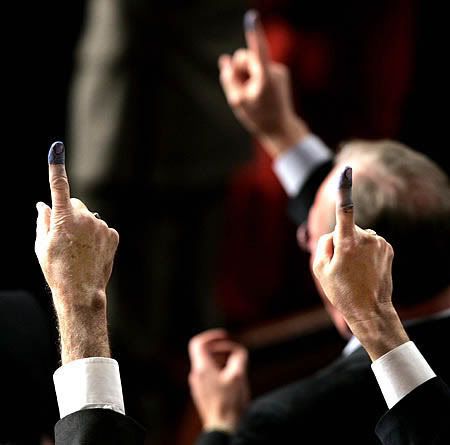
The purple fingers were a reference to a technique used in the Iraqi elections to protect against voter fraud. After casting their ballots, Iraqis had their fingers dipped in purple dye, in order to prevent multiple voting. The practice produced many media-friendly images which were broadcast widely on U.S. television in a self-congratulatory atmosphere, with pundits endlessly marvelling at how proud Americans should be for bringing democracy to the long-oppressed Iraqi people. One of the most iconic of these images was of a young Iraqi woman giving the "victory" sign with her purple-stained finger:
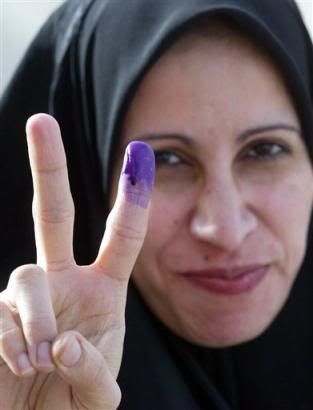
This image became a symbol of the hope that the U.S. had brought the people of Iraq, particularly the women.
But even at the time, most commentators seemed to miss the significance of the elections, which astute observers noted actually pointed to the desire of the Iraqi people for U.S. and coalition forces to leave their country. As Matthew Rothschild wrote in The Progressive,
Rothschild quoted Moayed Jassim Abed, a truck driver from Ramadi, who seemed to reflect the sentiments of many Iraqi voters, that their primary concern in electing their government was the ongoing problem of security. "We want security and stability," Abed said. "The Americans have been there three years and they have done worse than Saddam has done."
By participating in the electoral process and electing a national government, Abed, like so many other Iraqis, hoped that he would be hastening the day that the Americans would leave.
Beyond anecdotal evidence, Rothschild also cited a nationwide poll conducted just before the election:
A secret poll taken by the British Ministry of Defense less than a year later found an even greater majority of Iraqis opposing the presence of foreign troops in their country. The poll, reported the conservative British Telegraph, found that 82% of Iraqis opposed the occupation and that up to 65% of Iraqis supported attacks on occupation forces. Fewer than one percent thought that U.S. and British military involvement was helping to improve security in their country.
Now, two years later, with the security situation in Iraq worse than ever, it appears that the Iraqi parliament is finally coming to express the popular will of the Iraqi people. As the Washington Post reported last week,
For his part, Mitch McConnell said that if the Iraqi legislation passes, the U.S. would be happy to leave the country. "I want to assure you, if they vote to ask us to leave, we'll be glad to comply with their request," he said.
If so, it may mark the first time that Republicans actually respect the popular wishes of the people being occupied by U.S. forces, or for that matter, the American people, who also support ending the occupation as soon as possible. These wishes have been expressed both in public opinion polls, and at the voting booth. As Foreign Policy in Focus (FPIF) noted last week,
If other states begin to follow suit as FPIF predicts, and if the anti-occupation legislation passes in the Iraqi parliament, it could be interesting to watch just how stubborn George Bush and his allies in Congress remain in continuing this unpopular war. With the vast majority of the world, as well as the Iraqi and American people, opposed to the war, the Republican rationales for continuing it are increasingly difficult to justify.
Indeed, if by dipping their fingers in purple ink they meant to indicate their support for democracy -- either in Iraq or at home -- they would be working to end this war as soon as humanly possible.
As Reuters reported yesterday,
The top-ranking Republican in the U.S. Senate on Sunday expressed frustration with the Iraqi government, saying Republicans were "overwhelmingly disappointed" with the lack of political progress.
"The Iraqi government is a huge disappointment," Senate Minority Leader Mitch McConnell told CNN'S Late Edition on Sunday.
"So far, they've not been able do anything they promised on the political side," the Kentucky Republican said, citing the Iraqis' failure to pass a new oil revenue bill, hold local elections and dismantle the former Baath Party of Saddam Hussein. "It's a growing frustration."
"Republicans overwhelmingly feel disappointed about the Iraqi government," he added.
It's a far cry from the sentiment expressed at Bush's 2005 State of the Union address, given just weeks after Iraq's much-heralded national elections. At that that State of the Union, Republican lawmakers dyed their fingers purple in a gesture meant to convey their solidarity with the people of Iraq and its newly elected government.
The purple fingers were a reference to a technique used in the Iraqi elections to protect against voter fraud. After casting their ballots, Iraqis had their fingers dipped in purple dye, in order to prevent multiple voting. The practice produced many media-friendly images which were broadcast widely on U.S. television in a self-congratulatory atmosphere, with pundits endlessly marvelling at how proud Americans should be for bringing democracy to the long-oppressed Iraqi people. One of the most iconic of these images was of a young Iraqi woman giving the "victory" sign with her purple-stained finger:
This image became a symbol of the hope that the U.S. had brought the people of Iraq, particularly the women.
But even at the time, most commentators seemed to miss the significance of the elections, which astute observers noted actually pointed to the desire of the Iraqi people for U.S. and coalition forces to leave their country. As Matthew Rothschild wrote in The Progressive,
Despite President Bush's trumpeting of the elections as a symbol of support for the U.S. efforts, many Iraqi voters, like [Khalid] Kareem, cast their ballots to boot out the Americans. Even in Fallujah, a city that is one of the most potent symbols of resistance to the occupation and the new government, local leaders and resistance groups risked assassination by jihadis by encouraging their followers to vote and avoid attacking polling stations. In some cases, these leaders even called upon their people to protect polling stations from Al Qaeda operatives, who threatened death for anyone participating in the political process.
Rothschild quoted Moayed Jassim Abed, a truck driver from Ramadi, who seemed to reflect the sentiments of many Iraqi voters, that their primary concern in electing their government was the ongoing problem of security. "We want security and stability," Abed said. "The Americans have been there three years and they have done worse than Saddam has done."
By participating in the electoral process and electing a national government, Abed, like so many other Iraqis, hoped that he would be hastening the day that the Americans would leave.
Beyond anecdotal evidence, Rothschild also cited a nationwide poll conducted just before the election:
A recent Oxford Research Associates poll conducted for a number of Western media organizations found two-thirds of Iraqis oppose the presence of U.S. troops in their country. In the same poll, "occupation forces" came last behind religious leaders, police, the United Nations, the new Iraqi army, and political parties when Iraqis were asked, "How much confidence do you have in ...?" A survey conducted by Iraqi pollster Saadoun Al-Dulaimi (now the minister of defense) ahead of the January 2005 elections found that 85 percent of Iraqis wanted withdrawal "as soon as possible."
A secret poll taken by the British Ministry of Defense less than a year later found an even greater majority of Iraqis opposing the presence of foreign troops in their country. The poll, reported the conservative British Telegraph, found that 82% of Iraqis opposed the occupation and that up to 65% of Iraqis supported attacks on occupation forces. Fewer than one percent thought that U.S. and British military involvement was helping to improve security in their country.
Now, two years later, with the security situation in Iraq worse than ever, it appears that the Iraqi parliament is finally coming to express the popular will of the Iraqi people. As the Washington Post reported last week,
A majority of members of Iraq's parliament have signed a draft bill that would require a timetable for the withdrawal of U.S. soldiers from Iraq and freeze current troop levels. The development was a sign of a growing division between Iraq's legislators and prime minister that mirrors the widening gulf between the Bush administration and its critics in Congress.
The draft bill proposes a timeline for a gradual departure, much like what some U.S. Democratic lawmakers have demanded, and would require the Iraqi government to secure parliament's approval before any further extensions of the U.N. mandate for foreign troops in Iraq, which expires at the end of 2007.
For his part, Mitch McConnell said that if the Iraqi legislation passes, the U.S. would be happy to leave the country. "I want to assure you, if they vote to ask us to leave, we'll be glad to comply with their request," he said.
If so, it may mark the first time that Republicans actually respect the popular wishes of the people being occupied by U.S. forces, or for that matter, the American people, who also support ending the occupation as soon as possible. These wishes have been expressed both in public opinion polls, and at the voting booth. As Foreign Policy in Focus (FPIF) noted last week,
The congressional vote reflected public opinion about the war. Before the [November 2006 congressional] election, the Iraq war was a top priority for 61% of Democrats and 52% of Independents, compared to 38% of Republicans. Democratic Party leaders in both the House and the Senate have explained their effort to pass legislation to withdraw U.S. troops from Iraq as keeping faith with the voters in the November 2006 congressional elections, which brought Democrats to power. As Speaker of the House Nancy Pelosi (D-CA) put it, “Last fall, the American people voted for a new direction in Iraq.”
Public opinion has become even more opposed to the war since the November elections. A recent New York Times-CBS News poll found 64% of Americans supported a timeline for withdrawal in 2008. A CNN poll shows that 54% of American opposed the Bush veto of the deadline for withdrawal bill. In February 2007, the Vermont state legislature became the first in the union to support resolutions calling for immediate withdrawal of U.S. forces from Iraq. Other states may follow as they see the congressional initiative stall.
If other states begin to follow suit as FPIF predicts, and if the anti-occupation legislation passes in the Iraqi parliament, it could be interesting to watch just how stubborn George Bush and his allies in Congress remain in continuing this unpopular war. With the vast majority of the world, as well as the Iraqi and American people, opposed to the war, the Republican rationales for continuing it are increasingly difficult to justify.
Indeed, if by dipping their fingers in purple ink they meant to indicate their support for democracy -- either in Iraq or at home -- they would be working to end this war as soon as humanly possible.
Friday, May 11, 2007
Mumia's Chance for a New Trial: May 17
On May 17, oral arguments for death-row prisoner Mumia Abu-Jamal will be heard in the U.S. Court of Appeals for the Third Circuit, in Philadelphia, PA. In the following days, the court will decide whether Mumia will be granted a new trial, life in prison, or whether he shall be put to death.
The issues under consideration by the court will include whether Abu-Jamal was denied the right to due process of law and a fair trial under the Fifth, Sixth and Fourteenth Amendments because of the prosecutor’s “appeal-after-appeal” argument. This argument essentially encouraged the jury to disregard the presumption of innocence and reasonable doubt, and err on the side of guilt.
Also being considered on May 17 is whether the prosecution’s use of peremptory challenges to exclude African Americans from sitting on the jury violated Abu-Jamal’s rights to due process and equal protection under the law. In addition, the court will consider whether the jury instructions and verdict form that resulted in the death penalty deprived Abu-Jamal of rights guaranteed by the Eight and Fourteenth Amendments to due process of law.
After 25 years on Pennsylvania's death row, the May 17 court date may represent Abu-Jamal's best chance yet during his long incarceration for the chance of a new trial -- especially due to newly discovered evidence, such as a crime scene photograph from Dec. 9, 1981 that purportedly documents police manipulation of the scene.
For years, human rights and legal groups such as Amnesty International and the National Lawyers Guild have called his original trial deeply flawed and have been calling for a new chance for the former Black Panther and radio journalist to prove his innocence in the murder of police officer Daniel Faulkner. As Amnesty International said in 2000,
Indeed, as the New York-based International Action Center notes,
Many of these suspicions are fueled by the criticism that Mumia Abu-Jamal levels against the U.S. criminal justice system, the failures of American capitalism, and the injustices of U.S. foreign policy -- criticisms that are so scathing that they seem to go beyond the limits of acceptable political discourse in America. His imprisonment has not stopped him from continuing to speak out, with several books published over the years, and countless radio commentaries broadcast on Pacifica Radio and other outlets.
Many of the commentaries are now available on YouTube, and listening to him slam U.S. policy, one might be forgiven for reaching the conclusion that his voice is one that the U.S. government would simply love to silence:
Whether one subscribes to the view that Mumia is a victim of a system that has targetted him due to his political views, it has become increasingly difficult to justify his continued denial of a new trial. So much evidence has emerged since 1981 that points to his innocence, it is hard to imagine what more it might take for the Appeals Court to allow it to finally be heard. One man, Arnold Beverly, has even personally admitted to the murder of Daniel Faulkner, saying Mumia had nothing to do with it.
Furthermore, it has become clear that exonerating evidence was suppressed in his original trial, that key witnesses were intimidated from testifying, that other witnesses were intimidated into fingering Mumia as the shooter, and that his presiding judge, Albert Sabo, was on a personal crusade to send Mumia to death. With a fair hearing on May 17, there's a real possibility that Mumia may be given a new chance to prove his innocence in a court of law.
But as Amnesty notes in A Life in the Balance, "The politicization of Mumia Abu-Jamal's case may not only have prejudiced his right to a fair trial, but may now be undermining his right to fair and impartial treatment in the appeal courts." With this politicization in mind, many worry that Mumia will once again be denied a new trial and sent back to prison, where he has now spent more than half of his life.
In an attempt to ensure that Mumia is finally granted the fair trial that he has for so long been denied, several groups are urging concerned citizens to descend on the courthouse in Philadelphia on May 17. The Free Mumia Abu-Jamal Coalition is calling on people converge at 8:30 am at the U.S. Courthouse in Philadelphia on 6th and Market Streets to demand justice for Mumia.
The issues under consideration by the court will include whether Abu-Jamal was denied the right to due process of law and a fair trial under the Fifth, Sixth and Fourteenth Amendments because of the prosecutor’s “appeal-after-appeal” argument. This argument essentially encouraged the jury to disregard the presumption of innocence and reasonable doubt, and err on the side of guilt.
Also being considered on May 17 is whether the prosecution’s use of peremptory challenges to exclude African Americans from sitting on the jury violated Abu-Jamal’s rights to due process and equal protection under the law. In addition, the court will consider whether the jury instructions and verdict form that resulted in the death penalty deprived Abu-Jamal of rights guaranteed by the Eight and Fourteenth Amendments to due process of law.
After 25 years on Pennsylvania's death row, the May 17 court date may represent Abu-Jamal's best chance yet during his long incarceration for the chance of a new trial -- especially due to newly discovered evidence, such as a crime scene photograph from Dec. 9, 1981 that purportedly documents police manipulation of the scene.
For years, human rights and legal groups such as Amnesty International and the National Lawyers Guild have called his original trial deeply flawed and have been calling for a new chance for the former Black Panther and radio journalist to prove his innocence in the murder of police officer Daniel Faulkner. As Amnesty International said in 2000,
Amnesty International today called for a new trial in the case of Mumia Abu Jamal on the basis that his original trial was deeply flawed.Their exhaustively researched report, A Life In The Balance -- The Case of Mumia Abu-Jamal, was made available online. It begins by noting the international significance of Mumia's case:
"This is not about an issue affecting the life of just one man. This is about justice -- which affects us all. And justice, in this case, can only be served by a new trial," Amnesty International said.
After many years of monitoring the case and an exhaustive review of the original documents, Amnesty International has concluded that the proceedings under which Mumia Abu-Jamal was tried, convicted and sentenced to death fail to reach the minimum international standards for fair trials.
His case has generated more controversy and received more attention, both national and international, than that of any other inmate currently under sentence of death in the United States of America (USA).Having lived in Europe for a couple of years, I can vouch for the passionate commitment many Europeans have for his case. While travelling through Italy, I remember once seeing a huge mural of Mumia in Milan, and in Copenhagen, Denmark, I once joined a march of thousands of Danes to the US embassy demanding a new trial for Mumia.
Indeed, as the New York-based International Action Center notes,
Mumia Abu-Jamal is recognized internationally as a political prisoner whose Constitutional rights have been consistently violated in the state's mad dash to railroad him to execution. Mumia has been declared an honorary citizen of Paris, Palermo, the Central District of Copenhagen. Mumia was awarded the coveted Solhvervfonden Foundation Award in Copenhagen, Denmark for his services to humanity as a voice of conscience.While Amnesty International is careful not to identify him as a political prisoner, choosing instead to focus on the unfairness of his original trial, many around the world have no such qualms. While marching in Copenhagen, I remember asking one young Dane how much he knew about Mumia's case. He replied that he just knew that Mumia was an American political prisoner that the U.S. government was trying to execute in order to silence his voice.
Many of these suspicions are fueled by the criticism that Mumia Abu-Jamal levels against the U.S. criminal justice system, the failures of American capitalism, and the injustices of U.S. foreign policy -- criticisms that are so scathing that they seem to go beyond the limits of acceptable political discourse in America. His imprisonment has not stopped him from continuing to speak out, with several books published over the years, and countless radio commentaries broadcast on Pacifica Radio and other outlets.
Many of the commentaries are now available on YouTube, and listening to him slam U.S. policy, one might be forgiven for reaching the conclusion that his voice is one that the U.S. government would simply love to silence:
Whether one subscribes to the view that Mumia is a victim of a system that has targetted him due to his political views, it has become increasingly difficult to justify his continued denial of a new trial. So much evidence has emerged since 1981 that points to his innocence, it is hard to imagine what more it might take for the Appeals Court to allow it to finally be heard. One man, Arnold Beverly, has even personally admitted to the murder of Daniel Faulkner, saying Mumia had nothing to do with it.
Furthermore, it has become clear that exonerating evidence was suppressed in his original trial, that key witnesses were intimidated from testifying, that other witnesses were intimidated into fingering Mumia as the shooter, and that his presiding judge, Albert Sabo, was on a personal crusade to send Mumia to death. With a fair hearing on May 17, there's a real possibility that Mumia may be given a new chance to prove his innocence in a court of law.
But as Amnesty notes in A Life in the Balance, "The politicization of Mumia Abu-Jamal's case may not only have prejudiced his right to a fair trial, but may now be undermining his right to fair and impartial treatment in the appeal courts." With this politicization in mind, many worry that Mumia will once again be denied a new trial and sent back to prison, where he has now spent more than half of his life.
In an attempt to ensure that Mumia is finally granted the fair trial that he has for so long been denied, several groups are urging concerned citizens to descend on the courthouse in Philadelphia on May 17. The Free Mumia Abu-Jamal Coalition is calling on people converge at 8:30 am at the U.S. Courthouse in Philadelphia on 6th and Market Streets to demand justice for Mumia.
The New Emperor's New Clothes
By Inez Hollander, Ph.D.
May 11, 2007
In 2000 I lost my Dutch citizenship to become a God-fearing and patriotic American. This was never much of a moral dilemma as Lady Liberty had been a shining beacon throughout my life in The Netherlands.
Americans had liberated Holland when my parents were still teenagers: conversations around the dinner table sometimes went back to that moment of liberation when my parents had been dancing in the streets, decked out in red, white and blue, smoking American cigarettes and eating chocolate handed out by good-looking GIs.
Read on.
May 11, 2007
In 2000 I lost my Dutch citizenship to become a God-fearing and patriotic American. This was never much of a moral dilemma as Lady Liberty had been a shining beacon throughout my life in The Netherlands.
Americans had liberated Holland when my parents were still teenagers: conversations around the dinner table sometimes went back to that moment of liberation when my parents had been dancing in the streets, decked out in red, white and blue, smoking American cigarettes and eating chocolate handed out by good-looking GIs.
Read on.
Wednesday, May 09, 2007
Unrest in France Following a General Trend Across Europe
In France, anarchists and other leftists are reacting to the electoral victory of conservative Nicolas Sarkozy with riots, although you probably have not heard about the unrest in the U.S. media. While it is obvious that many of the rioters see Sarkozy as an anti-immigrant zealot and denounce him as a "fascist," informative reporting from the streets may be hindered by a law recently passed by the French Constitutional Council that effectively criminalizes the filming or broadcasting of acts of violence by people other than professional journalists.
Despite the new law, there is plenty of footage on YouTube, some of which we are providing here.
While there may not be one single issue that could be blamed for sparking the riots, it's worth noting that Sarkozy is decidedly pro-American, and with so much anger in France over the Iraq war and other unpopular U.S. policies, it shouldn't come as a great surprise that passions are so intense over the election results. Also, Sarkozy has vowed to tackle the French "welfare state," promising to “restore the value of work, authority, merit and respect for the nation.” In a country like France, with its 35-hour work week and generous vacation time, many see Sarkozy as a threat to their very way of life.
In a broader sense, it could also be pointed out that the riots seem to be following a general pattern that is being seen across Europe recently. From Greece to Italy to Denmark, people are taking to the streets -- sometimes violently -- to protest neoliberal economic policies such as the privatization of the university system in Greece and American encroachments into Europe such as the new military base proposed for Vicenza, Italy.
In typically tranquil Denmark, thousands of youth recently rioted in response to the Danish government's decision to shut down a decades-old anarchist squat known as Ungdomshuset, or "The Youth House." Following the eviction of Ungdomshuset, the Copenhagen neighborhood of Norrebro became the scene of ongoing street battles for several days:
A similar scene played out in Greece in March, when the Greek constitution was amended to allow privatization of the country's university system:
These scenes of violence may soon sweep Italy as well, if the U.S. government carries through on its plans to make the northeastern Italian town of Vicenza the largest US military site in Europe. David Swanson of AfterDowningStreet.org reported yesterday that "the people of Vicenza, and all of Italy, have sworn it will never happen," and noted that in February 200,000 people descended on the town in protest of the plans.
While so far the demonstrations have been peaceful, it should not come as a great surprise if Italian anger over the proposed base spills into violence, if recent trends across Europe are any indication.
Despite the new law, there is plenty of footage on YouTube, some of which we are providing here.
While there may not be one single issue that could be blamed for sparking the riots, it's worth noting that Sarkozy is decidedly pro-American, and with so much anger in France over the Iraq war and other unpopular U.S. policies, it shouldn't come as a great surprise that passions are so intense over the election results. Also, Sarkozy has vowed to tackle the French "welfare state," promising to “restore the value of work, authority, merit and respect for the nation.” In a country like France, with its 35-hour work week and generous vacation time, many see Sarkozy as a threat to their very way of life.
In a broader sense, it could also be pointed out that the riots seem to be following a general pattern that is being seen across Europe recently. From Greece to Italy to Denmark, people are taking to the streets -- sometimes violently -- to protest neoliberal economic policies such as the privatization of the university system in Greece and American encroachments into Europe such as the new military base proposed for Vicenza, Italy.
In typically tranquil Denmark, thousands of youth recently rioted in response to the Danish government's decision to shut down a decades-old anarchist squat known as Ungdomshuset, or "The Youth House." Following the eviction of Ungdomshuset, the Copenhagen neighborhood of Norrebro became the scene of ongoing street battles for several days:
A similar scene played out in Greece in March, when the Greek constitution was amended to allow privatization of the country's university system:
These scenes of violence may soon sweep Italy as well, if the U.S. government carries through on its plans to make the northeastern Italian town of Vicenza the largest US military site in Europe. David Swanson of AfterDowningStreet.org reported yesterday that "the people of Vicenza, and all of Italy, have sworn it will never happen," and noted that in February 200,000 people descended on the town in protest of the plans.
Largely as a result [of the protest], the Prime Minister of Italy was (temporarily) driven out of power. Meanwhile, just outside Vicenza, large tents now hold newly minted citizen activists keeping a 24-hour-per-day vigil and training hundreds of senior citizens, children, and families every day in how to nonviolently stop bulldozers. The bulldozers they are waiting for are American.
The conflict, should it come about, will be as surprising to American television viewers as were the attacks of 9-11, unless someone tells them ahead of time what is going on. This week a group of Italians is in Washington, D.C., attempting to do just that. A group of Italian Members of Parliament also visited Washington last month in opposition to the base.
While so far the demonstrations have been peaceful, it should not come as a great surprise if Italian anger over the proposed base spills into violence, if recent trends across Europe are any indication.
Panel Calls for Due Process for Journalists Held by U.S. Military
On a panel held yesterday in connection with World Press Freedom Day, representatives of two journalists held by the U.S. military called upon the U.S. to either charge them with crimes or release them. Associated Press photographer Bilal Hussein has been held in Iraq for a year, and Sami al-Hajj, a cameraman for the Middle East television station Al-Jazeera, has been detained since late 2001 and is currently at the military prison at Guantanamo Bay, Cuba. Neither have been provided an opportunity to prove their innocence in a court of law.
U.S. officials claim that because Hussein took photographs of explosions in Iraq, that he must have been at the locations ahead of time, and therefore complicit with the Iraqi insurgency. But Kathleen Carroll, executive editor of the AP, said he was "simply the unlucky fellow who happened to be the photographer for the world's largest newsgathering organization in a difficult province." She called the U.S. claims against him a "rolling set of allegations that arise and then disappear without the benefit of a trial."
Similarly, Al-Hajj has faced varying allegations, but has been denied the opportunity to refute them because the U.S. government has never filed charges or presented evidence against him. He has been in custody since he was stopped at the Afghanistan border by Pakistani authorities in December 2001 and turned over to U.S. authorities six months later.
His attorney, Zachary Katznelson, pointed out that the evidence being used to justify al-Hajj's detention is classified, so neither the journalist, his lawyers, nor the public have been able to see it. In al-Hajj's ongoing interrogations at Guantanamo, U.S. officials have focused almost exclusively on obtaining intelligence regarding al-Jazeera and its staff. His interrogators have told him that he would be released if he provided information about the satellite network’s activities, an offer that al-Hajj has consistently refused. Al-Hajj, who has been force-fed while on a hunger strike to protest his incarceration, appeared weak during a recent visit, the lawyer said.
Katznelson called upon the U.S. to make public the classified evidence that the U.S. says justifies his detention. "If there is any evidence, then let's see it," Katznelson said.
The Committee to Protect Journalists (CPJ), which sponsored yesterday's panel at the National Press Club, details Al-Hajj's case in a 2006 report called, "The Enemy?"
In the report, CPJ notes that al-Hajj
CPJ also notes that the detentions of al-Hajj and Hussein are part of an ongoing pattern by the U.S. military to detain reporters without charges, in what could be seen as a concerted campaign of intimidation.
Even without the arbitrary detentions of journalists by the U.S. military, Iraq is already the most dangerous place in the world for reporters to work. Of the 56 confirmed deaths of journalists worldwide in 2006, CPJ notes that 32 were in Iraq.
The latest victim was Dmitry Chebotayev, a Russian photographer killed on Sunday in Baqouba. He was 29 years old.
U.S. officials claim that because Hussein took photographs of explosions in Iraq, that he must have been at the locations ahead of time, and therefore complicit with the Iraqi insurgency. But Kathleen Carroll, executive editor of the AP, said he was "simply the unlucky fellow who happened to be the photographer for the world's largest newsgathering organization in a difficult province." She called the U.S. claims against him a "rolling set of allegations that arise and then disappear without the benefit of a trial."
Similarly, Al-Hajj has faced varying allegations, but has been denied the opportunity to refute them because the U.S. government has never filed charges or presented evidence against him. He has been in custody since he was stopped at the Afghanistan border by Pakistani authorities in December 2001 and turned over to U.S. authorities six months later.
His attorney, Zachary Katznelson, pointed out that the evidence being used to justify al-Hajj's detention is classified, so neither the journalist, his lawyers, nor the public have been able to see it. In al-Hajj's ongoing interrogations at Guantanamo, U.S. officials have focused almost exclusively on obtaining intelligence regarding al-Jazeera and its staff. His interrogators have told him that he would be released if he provided information about the satellite network’s activities, an offer that al-Hajj has consistently refused. Al-Hajj, who has been force-fed while on a hunger strike to protest his incarceration, appeared weak during a recent visit, the lawyer said.
Katznelson called upon the U.S. to make public the classified evidence that the U.S. says justifies his detention. "If there is any evidence, then let's see it," Katznelson said.
The Committee to Protect Journalists (CPJ), which sponsored yesterday's panel at the National Press Club, details Al-Hajj's case in a 2006 report called, "The Enemy?"
In the report, CPJ notes that al-Hajj
has been held for nearly five years on the basis of secret evidence; he has not been convicted or even charged with a crime. Until this year—when an Associated Press lawsuit prompted the Pentagon to identify the detainees—the military would not acknowledge al-Haj was in custody. Al-Haj’s lawyer, who has been barred from attending his client’s hearings, has called the allegations baseless and the justice system at Guantanamo a sham.
“There is absolutely zero evidence that he has any history in terrorism at all,” said Clive Stafford Smith, legal director of Reprieve, a London-based human rights group, who took up al-Haj’s case in 2005. Stafford Smith contends that al-Haj’s continued detention is political, and the main focus of U.S. interrogators has not been al-Haj’s alleged terrorist activities but obtaining intelligence on Al-Jazeera and its staff.
CPJ also notes that the detentions of al-Hajj and Hussein are part of an ongoing pattern by the U.S. military to detain reporters without charges, in what could be seen as a concerted campaign of intimidation.
Hussein’s detention is not an isolated incident in Iraq. Over the last four years, dozens of journalists, mostly Iraqis, have been detained by U.S. troops, according to CPJ research. While most have been released after short periods, in at least eight cases documented by CPJ Iraqi journalists have been held by U.S. forces for weeks or months without charge or conviction. In all previous detentions journalists were released without charges ever being substantiated.
Even without the arbitrary detentions of journalists by the U.S. military, Iraq is already the most dangerous place in the world for reporters to work. Of the 56 confirmed deaths of journalists worldwide in 2006, CPJ notes that 32 were in Iraq.
The latest victim was Dmitry Chebotayev, a Russian photographer killed on Sunday in Baqouba. He was 29 years old.
The Right's Parallel Universe
By Richard L. Fricker
May 9, 2007
To understand how the United States got itself into its current fix, it’s helpful to understand that the American Right and its powerful media apparatus have created a kind of parallel universe that has its own internal logic that sort of makes sense even if the “reality” isn’t exactly real.
So, on the Iraq War, everything is going pretty well except, as Fox News reminds its viewers, the “liberal media” keeps hiding all the positive developments from the American people. Plus, the only way to explain hostility toward George W. Bush is to postulate that his critics are consumed by irrational hatreds. The Right’s reality-divergent narrative exists on domestic policy, too.
Read on.
May 9, 2007
To understand how the United States got itself into its current fix, it’s helpful to understand that the American Right and its powerful media apparatus have created a kind of parallel universe that has its own internal logic that sort of makes sense even if the “reality” isn’t exactly real.
So, on the Iraq War, everything is going pretty well except, as Fox News reminds its viewers, the “liberal media” keeps hiding all the positive developments from the American people. Plus, the only way to explain hostility toward George W. Bush is to postulate that his critics are consumed by irrational hatreds. The Right’s reality-divergent narrative exists on domestic policy, too.
Read on.
Blaming the Iraqis
By Ivan Eland
May 9, 2007
The Bush administration and Congress have put too much faith in governments—the U.S. as well as the Iraqi—to remedy the chaos in Iraq.
To keep the pressure on the administration for eventual U.S. troop withdrawals, the Democrats have already begun to blame the Iraqi government for not meeting benchmarks for progress and are threatening to include them in legislation.
Read on.
May 9, 2007
The Bush administration and Congress have put too much faith in governments—the U.S. as well as the Iraqi—to remedy the chaos in Iraq.
To keep the pressure on the administration for eventual U.S. troop withdrawals, the Democrats have already begun to blame the Iraqi government for not meeting benchmarks for progress and are threatening to include them in legislation.
Read on.
Tuesday, May 08, 2007
Qaeda's Reverse-Reverse Psychology
By Robert Parry
May 8, 2007
George W. Bush loves to tell his audiences that they must “listen to the words of the enemy” and “take their words seriously,” thus setting up his argument that al-Qaeda wants the United States to leave Iraq so the U.S. military must stay in Iraq
Like much of what Bush has said about the Iraq War, this presidential homespun wisdom always has had more emotional appeal than actual logic. But a newly released videotape from al-Qaeda’s second-in-command Ayman al-Zawahiri demonstrates why Bush’s argument has never made sense.
Read on.
May 8, 2007
George W. Bush loves to tell his audiences that they must “listen to the words of the enemy” and “take their words seriously,” thus setting up his argument that al-Qaeda wants the United States to leave Iraq so the U.S. military must stay in Iraq
Like much of what Bush has said about the Iraq War, this presidential homespun wisdom always has had more emotional appeal than actual logic. But a newly released videotape from al-Qaeda’s second-in-command Ayman al-Zawahiri demonstrates why Bush’s argument has never made sense.
Read on.
Monday, May 07, 2007
Bush Sat on Evidence of Cuban Terror
By Robert Parry
May 7, 2007
Earlier this year, as accused right-wing terrorist Luis Posada Carilles successfully sought to be freed on bond, the Bush administration possessed secret evidence implicating the 79-year-old Cuban exile in terrorist bombings in Havana a decade ago.
The evidence, an FBI document based on interviews with confidential sources in the late 1990s, linked Posada to a wave of hotel bombings in 1997 that killed an Italian tourist. Administration lawyers have now filed the document in court as part of the illegal immigration case against Posada that is scheduled to resume in Texas on May 11.
Read on.
May 7, 2007
Earlier this year, as accused right-wing terrorist Luis Posada Carilles successfully sought to be freed on bond, the Bush administration possessed secret evidence implicating the 79-year-old Cuban exile in terrorist bombings in Havana a decade ago.
The evidence, an FBI document based on interviews with confidential sources in the late 1990s, linked Posada to a wave of hotel bombings in 1997 that killed an Italian tourist. Administration lawyers have now filed the document in court as part of the illegal immigration case against Posada that is scheduled to resume in Texas on May 11.
Read on.
Sunday, May 06, 2007
Tenet-Bush Pre-9/11 'Small Talk'
By Robert Parry
May 6, 2007
In late August 2001, when aggressive presidential action might have changed the course of U.S. history, CIA Director George Tenet made a special trip to Crawford, Texas, to get George W. Bush to focus on an imminent threat of a spectacular al-Qaeda attack only to have the conversation descend into meaningless small talk.
Alarmed CIA officials already had held an extraordinary meeting with then-national security adviser Condoleezza Rice on July 10 to lay out the accumulating evidence of an impending attack and had delivered on Aug. 6 a special “Presidential Daily Brief” to Bush entitled “Bin Laden Determined to Strike in US.”
Read on.
May 6, 2007
In late August 2001, when aggressive presidential action might have changed the course of U.S. history, CIA Director George Tenet made a special trip to Crawford, Texas, to get George W. Bush to focus on an imminent threat of a spectacular al-Qaeda attack only to have the conversation descend into meaningless small talk.
Alarmed CIA officials already had held an extraordinary meeting with then-national security adviser Condoleezza Rice on July 10 to lay out the accumulating evidence of an impending attack and had delivered on Aug. 6 a special “Presidential Daily Brief” to Bush entitled “Bin Laden Determined to Strike in US.”
Read on.
Saturday, May 05, 2007
The Ongoing Iraq Intel Fraud
By Robert Parry
May 5, 2007
Almost five years and perhaps half a million deaths too late, it’s finally the accepted wisdom in Washington that the intelligence that George W. Bush used to justify invading Iraq was garbage. But the pattern of twisting the truth about Iraq continues unabated and the President is still rarely called on it.
Bush has never stopped making statements about the Iraq War that are untrue, illogical or irrelevant. Yet, the Washington press corps remains almost as lax today about holding Bush accountable as it was in 2002 and 2003.
Read on.
May 5, 2007
Almost five years and perhaps half a million deaths too late, it’s finally the accepted wisdom in Washington that the intelligence that George W. Bush used to justify invading Iraq was garbage. But the pattern of twisting the truth about Iraq continues unabated and the President is still rarely called on it.
Bush has never stopped making statements about the Iraq War that are untrue, illogical or irrelevant. Yet, the Washington press corps remains almost as lax today about holding Bush accountable as it was in 2002 and 2003.
Read on.
Friday, May 04, 2007
Echoes of Cold War in Russia-Estonia Spat
There is an interesting article at Antiwar.com today (written by Patrick Buchannan of all people), dealing with the current tension between Russia and Estonia. In case you weren't aware, Estonia is becoming increasingly angry with Moscow, saying that the Russian government is not meeting international standards for protecting diplomats. As Buchannan explains,
At issue is a decision by the Estonian government to relocate a Soviet-era statue, which to many Estonians is a symbol of Soviet oppression, but to many Russians is a symbol of their sacrifice in liberating Estonia from Nazi occupation. The tension continues to escalate, as Russia announced on Wednesday that it would halt deliveries of oil products to the small Baltic nation.
Although Americans tend not to concern themselves much with the affairs of Europe, in this situation, the U.S. could find itself directly involved, if the situation continues to deterioriate. As Buchannan further explains,
While many readers might disagree with Buchannan on other issues, on this particular matter, he has a good point.
Although the conventional view is that the Cold War ended with the fall of the Berlin Wall and the subsequent collapse of the Soviet Union, in significant ways, the East-West competition that characterized the Cold War never really ended. Indeed, that East-West competition actually predated the Cold War, going back to the days of the Russian Empire.
This is why Russia has always seen it as a provocation for NATO to expand all the way to its doorstep, and indeed, the fact the U.S. insists on continuing to expand the NATO alliance can only be seen as an attempt to expand Western and U.S. power at the expense of Russian hegemony.
The neoconservatives in the Bush administration have taken a provocative stance towards Russia almost since day one. Indeed, one of the first foreign policy acts of the Bush administration was to expel dozens of Russian diplomats from Washington, accusing them of being spies. The act was widely seen as provocative in Russia, as well as in Europe.
The Bush administration also announced early on that it would revive a Reagan era project known as the Strategic Defense Initiative, aka, "Star Wars." (See Ivan Eland's article below for more information.) This was also seen by Russia as an act of outright provocation, since it would seem to violate numerous treaties, including the Outer Space Treaty, the Anti-Ballistic Missile Treaty (ABM), and the Nuclear Non-Proliferation Treaty. Bush confirmed Russian fears a few months later, when he announced the official U.S. withdrawal from the ABM treaty.
"I have concluded the ABM treaty hinders our government's ability to develop ways to protect our people from future terrorist or rogue-state missile attacks," Bush announced in December 2001.
Predictably, Putin responded coolly to the decision, but apparently was not surprised. "This step was not a surprise for us. However, we consider it a mistake," he said. Most significantly, the development of a missile shield would disrupt the doctrine of mutually assured destruction, which was the cornerstone of the U.S.-Russian balance of power for the entire Cold War.
Following 9/11, the U.S. began further encroaching on Russia's traditional sphere of influence, hatching secret bilateral agreements with autocratic Central Asian nations, and even sending troops into the murky and complicated geopolitical mess in the Caucasus. As I explained in an article written in 2002:
This perceived American overreaching led a group of retired Russian military generals to brand Putin a Western lackey and a traitor to Russian interests. "With your [Putin's] blessing, the United States has received military bases in Uzbekistan, Tajikistan, Kyrgyzstan, and, maybe, Kazakhstan," the generals declared in a published broadside. "In the long run, these bases are for dealing a strike on Russia, not bin Laden."
For years, Putin was somewhat restrained in his criticism of U.S. policy, but that restraint was abandoned in a speech at security conference this February. “The U.S. has overstepped its political limits in almost all spheres,” Putin told the meeting of policy makers with U.S. Secretary of Defense Robert Gates in the audience. “We are witnessing an almost unrestrained hyper-use of force in international relations,” Putin said, adding that Russia doesn’t need lessons in democracy from “people who didn’t practice it themselves.”
Now, Putin and Russian diplomats are slamming the West again, for its perceived support for Estonia in its current row over the Soviet statue. As AFP reported yesterday,
Whether the tension will continue to escalate is a matter of speculation, but what is clear is that the competitive East-West dynamic of the Cold War has by no means passed, and that indeed, the policies of the Bush administration -- beginning with its initial decision to expel some 50 Russian diplomats in March 2001 -- has probably done more to fuel the tension than any actions taken by the other two post-Cold War American administrations.
We can only hope that Buchannan is being paranoid when he forsees a possible armed conflict between Russia and Estonia, which according to NATO treaty obligations, could bring the U.S. into open war with Russia. As Buchannan points out, Russia is "a nuclear power that has the ability to inflict 1,000 times the destruction upon us as Iran."
All week, young toughs in Moscow have besieged the Estonian embassy to harass Ambassador Marina Kaljurand. Her bodyguards had to use a mace-like spray to drive back the thugs, who call Estonia a "fascist country." Estonian diplomats and their families are being pulled out of Moscow and sent home.
Relations between the countries are about to rupture, if the Kremlin does not reign in the bully-boys.
At issue is a decision by the Estonian government to relocate a Soviet-era statue, which to many Estonians is a symbol of Soviet oppression, but to many Russians is a symbol of their sacrifice in liberating Estonia from Nazi occupation. The tension continues to escalate, as Russia announced on Wednesday that it would halt deliveries of oil products to the small Baltic nation.
Although Americans tend not to concern themselves much with the affairs of Europe, in this situation, the U.S. could find itself directly involved, if the situation continues to deterioriate. As Buchannan further explains,
If President Putin decides the Estonians need a lesson, and sends troops to teach it, the United States, under NATO, would have to treat Russian intervention in Estonia as an attack upon the United States, and declare war on behalf of Estonia.
So we come face to face with the idiocy of having moved NATO onto Russia's front porch, and having given war guarantees to three little nations with historic animosities toward a nuclear power that has the ability to inflict 1,000 times the destruction upon us as Iran.
While many readers might disagree with Buchannan on other issues, on this particular matter, he has a good point.
Although the conventional view is that the Cold War ended with the fall of the Berlin Wall and the subsequent collapse of the Soviet Union, in significant ways, the East-West competition that characterized the Cold War never really ended. Indeed, that East-West competition actually predated the Cold War, going back to the days of the Russian Empire.
This is why Russia has always seen it as a provocation for NATO to expand all the way to its doorstep, and indeed, the fact the U.S. insists on continuing to expand the NATO alliance can only be seen as an attempt to expand Western and U.S. power at the expense of Russian hegemony.
The neoconservatives in the Bush administration have taken a provocative stance towards Russia almost since day one. Indeed, one of the first foreign policy acts of the Bush administration was to expel dozens of Russian diplomats from Washington, accusing them of being spies. The act was widely seen as provocative in Russia, as well as in Europe.
The Bush administration also announced early on that it would revive a Reagan era project known as the Strategic Defense Initiative, aka, "Star Wars." (See Ivan Eland's article below for more information.) This was also seen by Russia as an act of outright provocation, since it would seem to violate numerous treaties, including the Outer Space Treaty, the Anti-Ballistic Missile Treaty (ABM), and the Nuclear Non-Proliferation Treaty. Bush confirmed Russian fears a few months later, when he announced the official U.S. withdrawal from the ABM treaty.
"I have concluded the ABM treaty hinders our government's ability to develop ways to protect our people from future terrorist or rogue-state missile attacks," Bush announced in December 2001.
Predictably, Putin responded coolly to the decision, but apparently was not surprised. "This step was not a surprise for us. However, we consider it a mistake," he said. Most significantly, the development of a missile shield would disrupt the doctrine of mutually assured destruction, which was the cornerstone of the U.S.-Russian balance of power for the entire Cold War.
Following 9/11, the U.S. began further encroaching on Russia's traditional sphere of influence, hatching secret bilateral agreements with autocratic Central Asian nations, and even sending troops into the murky and complicated geopolitical mess in the Caucasus. As I explained in an article written in 2002:
The Russian government of Vladimir Putin has criticized the Georgian government of Eduard Schevardnadze for giving safe haven to the Chechen rebels. Meanwhile, Schevardnadze’s Georgian government has blamed Putin’s Russia for aiding and abetting separatists from the Abkhazia and South Ossetia regions of Georgia.
While rebels in Chechnya want to break away from Russia, rebels in Abkhazia and South Ossetia want to break away from Georgia. Complicating matters further, the Chechen civil war has been the scene of widespread human rights abuses on both sides, while the Georgian region of Abkhazia has had its own ugly scenes of ethnic cleansing.
Into this maelstrom of regional and ethnic warfare now steps George W. Bush and his “crusade” to “rid the world of evil.” The Bush administration wants U.S. troops to assist Georgian soldiers in hunting down and killing al-Qaeda fighters holed up in Georgia’s lawless Pankisi Gorge.
This perceived American overreaching led a group of retired Russian military generals to brand Putin a Western lackey and a traitor to Russian interests. "With your [Putin's] blessing, the United States has received military bases in Uzbekistan, Tajikistan, Kyrgyzstan, and, maybe, Kazakhstan," the generals declared in a published broadside. "In the long run, these bases are for dealing a strike on Russia, not bin Laden."
For years, Putin was somewhat restrained in his criticism of U.S. policy, but that restraint was abandoned in a speech at security conference this February. “The U.S. has overstepped its political limits in almost all spheres,” Putin told the meeting of policy makers with U.S. Secretary of Defense Robert Gates in the audience. “We are witnessing an almost unrestrained hyper-use of force in international relations,” Putin said, adding that Russia doesn’t need lessons in democracy from “people who didn’t practice it themselves.”
Now, Putin and Russian diplomats are slamming the West again, for its perceived support for Estonia in its current row over the Soviet statue. As AFP reported yesterday,
Russia lashed out Thursday at the European Union and NATO for supporting Estonia in its row with Moscow over the relocation of a Soviet war monument.
Russia's representative to the Organisation for Security and Cooperation in Europe, Alexei Borodavkin, attacked what he called EU and NATO "indifference and connivance."
"What happened in Estonia ... cannot fail to affect relations between Russia and the European Union and the North Atlantic alliance," he was quoted as saying by Interfax news agency.
Whether the tension will continue to escalate is a matter of speculation, but what is clear is that the competitive East-West dynamic of the Cold War has by no means passed, and that indeed, the policies of the Bush administration -- beginning with its initial decision to expel some 50 Russian diplomats in March 2001 -- has probably done more to fuel the tension than any actions taken by the other two post-Cold War American administrations.
We can only hope that Buchannan is being paranoid when he forsees a possible armed conflict between Russia and Estonia, which according to NATO treaty obligations, could bring the U.S. into open war with Russia. As Buchannan points out, Russia is "a nuclear power that has the ability to inflict 1,000 times the destruction upon us as Iran."
Missile Defense Seen as Dangerous
By Ivan Eland
May 4, 2007
President Bush’s plan to deploy missile defenses in Central Europe will reduce U.S. security, not enhance it. Installing radar for tracking incoming missiles in the Czech Republic and anti-missile interceptors in Poland could do more harm than good.
Ostensibly, the European radar and interceptors are aimed at the future threat of nuclear-armed Iranian missiles. But Russia suspects—perhaps with good reason—that the real purpose of the deployments is to cement the security guarantees the United States has given to the two former Russian allies.
Read on.
May 4, 2007
President Bush’s plan to deploy missile defenses in Central Europe will reduce U.S. security, not enhance it. Installing radar for tracking incoming missiles in the Czech Republic and anti-missile interceptors in Poland could do more harm than good.
Ostensibly, the European radar and interceptors are aimed at the future threat of nuclear-armed Iranian missiles. But Russia suspects—perhaps with good reason—that the real purpose of the deployments is to cement the security guarantees the United States has given to the two former Russian allies.
Read on.
Thursday, May 03, 2007
Setting the Table, with All the Options
By Peter Dyer
May 3, 2007
There is a consensus among American foreign policy makers and major presidential candidates: “All options are on the table.” This phrase has been repeated so often by so many that it is now a cliche.
It seems reasonable enough. When faced with a problem, most of us would like to have at our disposal any and all tools available to remedy the problem.
But what do these words really mean when used by the most powerful people in the world’s most powerful country? The bland lanaguage of the cliche masks its implicit terror.
Read on.
May 3, 2007
There is a consensus among American foreign policy makers and major presidential candidates: “All options are on the table.” This phrase has been repeated so often by so many that it is now a cliche.
It seems reasonable enough. When faced with a problem, most of us would like to have at our disposal any and all tools available to remedy the problem.
But what do these words really mean when used by the most powerful people in the world’s most powerful country? The bland lanaguage of the cliche masks its implicit terror.
Read on.
Tenet's Disgraceful Apologia
By Ray McGovern
May 3, 2007
“If you can’t say something positive about someone, don’t say anything.” This was drummed into me by my Irish grandmother and, as was the case with most of her admonishments, it has stood me in good stead. On occasion, though, it has been a real bother—as when I felt called to comment on George Tenet’s apologia, In the Center of the Storm, now at a bookstore near you.
On the verge of despair, I ran into an old classmate of Tenet’s from PS 94 in Little Neck, Queens. Help at last. He told me that George was more handsome than his twin brother Billy, and that his outgoing nature and consummate political skill got him elected president of the student body.
Positive enough, Grandma? Now let me add this.
Read on.
May 3, 2007
“If you can’t say something positive about someone, don’t say anything.” This was drummed into me by my Irish grandmother and, as was the case with most of her admonishments, it has stood me in good stead. On occasion, though, it has been a real bother—as when I felt called to comment on George Tenet’s apologia, In the Center of the Storm, now at a bookstore near you.
On the verge of despair, I ran into an old classmate of Tenet’s from PS 94 in Little Neck, Queens. Help at last. He told me that George was more handsome than his twin brother Billy, and that his outgoing nature and consummate political skill got him elected president of the student body.
Positive enough, Grandma? Now let me add this.
Read on.
Thursday, April 26, 2007
Washington's Bloody Make-Believe
By Carla Binion
April 26, 2007
It's astonishing that members of Congress are either unaware George W. Bush and Dick Cheney lied the nation to war with Iraq, or they are aware of the fact and don't care. A Congress grounded in reality would have unequivocally acknowledged the administration's lies long ago and taken appropriate action - almost certainly impeachment.
If we say the pre-war lies don't matter and the country should sweep them under the rug and only focus on the best way out of Iraq, what we're really saying is that the truth itself doesn't matter.
Read on.
April 26, 2007
It's astonishing that members of Congress are either unaware George W. Bush and Dick Cheney lied the nation to war with Iraq, or they are aware of the fact and don't care. A Congress grounded in reality would have unequivocally acknowledged the administration's lies long ago and taken appropriate action - almost certainly impeachment.
If we say the pre-war lies don't matter and the country should sweep them under the rug and only focus on the best way out of Iraq, what we're really saying is that the truth itself doesn't matter.
Read on.
Wednesday, April 25, 2007
Dying for W
By Robert Parry
April 25, 2007
George W. Bush admits he has no evidence that a withdrawal timetable from Iraq would be harmful. Instead, the President told interviewer Charlie Rose that this core assumption behind his veto threat of a Democratic war appropriation bill is backed by “just logic.”
“I mean, you say we start moving troops out,” Bush said in the interview on April 24. “Don’t you think an enemy is going to wait and adjust based upon an announced timetable for withdrawal?”
It is an argument that Bush has made again and again over the past few years, that with a withdrawal timetable, the “enemy” would just “wait us out.” But the answer to Bush’s rhetorical question could be, “well, so what if they do?”
Read on.
April 25, 2007
George W. Bush admits he has no evidence that a withdrawal timetable from Iraq would be harmful. Instead, the President told interviewer Charlie Rose that this core assumption behind his veto threat of a Democratic war appropriation bill is backed by “just logic.”
“I mean, you say we start moving troops out,” Bush said in the interview on April 24. “Don’t you think an enemy is going to wait and adjust based upon an announced timetable for withdrawal?”
It is an argument that Bush has made again and again over the past few years, that with a withdrawal timetable, the “enemy” would just “wait us out.” But the answer to Bush’s rhetorical question could be, “well, so what if they do?”
Read on.
Exaggerating al-Qaeda's Threat
By Ivan Eland
April 25, 2007
Michael Chertoff, President Bush’s secretary of Homeland Security, desperately tried to refute Zbigniew Brzezinski’s cogent charge that the administration has hyped the “war on terror” to promote a “culture of fear,” in a recent Washington Post op-ed.
In addition to shamefully smearing Brzezinski, Jimmy Carter’s former National Security Advisor, by associating him with the fringe opinion that the administration plotted the 9/11 terrorist acts, Chertoff also declared, “Al-Qaeda and its ilk have a world vision that is comparable to that of historical totalitarian ideologues but adapted to the 21st–century global network.”
Read on.
April 25, 2007
Michael Chertoff, President Bush’s secretary of Homeland Security, desperately tried to refute Zbigniew Brzezinski’s cogent charge that the administration has hyped the “war on terror” to promote a “culture of fear,” in a recent Washington Post op-ed.
In addition to shamefully smearing Brzezinski, Jimmy Carter’s former National Security Advisor, by associating him with the fringe opinion that the administration plotted the 9/11 terrorist acts, Chertoff also declared, “Al-Qaeda and its ilk have a world vision that is comparable to that of historical totalitarian ideologues but adapted to the 21st–century global network.”
Read on.
Monday, April 23, 2007
Explaining Cheney's Iraq War Smirk
By Ray McGovern
April 24, 2007
Never before have I felt such irk from a Cheney smirk -- the one with which he confidently assured CBS's Bob Schieffer on April 15's "Face the Nation" that the Democrats will continue to vote to fund the war without including serious restrictions.
Cheney referred approvingly to the fact that "Carl Levin, who's chairman of the Senate Armed Services Committee, has indicated that they definitely do want to pass funding for the troops."
Read on.
April 24, 2007
Never before have I felt such irk from a Cheney smirk -- the one with which he confidently assured CBS's Bob Schieffer on April 15's "Face the Nation" that the Democrats will continue to vote to fund the war without including serious restrictions.
Cheney referred approvingly to the fact that "Carl Levin, who's chairman of the Senate Armed Services Committee, has indicated that they definitely do want to pass funding for the troops."
Read on.
Saturday, April 21, 2007
Hypocrisy: Thy Name Is Bush
By Robert Parry
April 21, 2007
George W. Bush likes to present the “war on terror” as a clear-cut moral crusade in which evildoers who kill innocent civilians must be brought harshly to justice, along with the leaders of countries that harbor terrorists. There are no grays, only blacks and whites.
But evenhanded justice is not the true core principle of the Bush Doctrine. The real consistency is hypocrisy: violence which Bush favors – no matter how wanton the slaughter of innocents – is justifiable, while violence that goes against Bush’s interests – even an insurgency against a foreign military occupation – must be punished without remorse as “terrorism.”
Read on.
April 21, 2007
George W. Bush likes to present the “war on terror” as a clear-cut moral crusade in which evildoers who kill innocent civilians must be brought harshly to justice, along with the leaders of countries that harbor terrorists. There are no grays, only blacks and whites.
But evenhanded justice is not the true core principle of the Bush Doctrine. The real consistency is hypocrisy: violence which Bush favors – no matter how wanton the slaughter of innocents – is justifiable, while violence that goes against Bush’s interests – even an insurgency against a foreign military occupation – must be punished without remorse as “terrorism.”
Read on.
Friday, April 20, 2007
Gonzales & the 'Mayberry Machiavellis'
By Robert Parry
April 20, 2007
Watching the painfully inept testimony of Attorney General Alberto Gonzales brought to mind the memorable comment in 2002 by ex-White House insider John DiIulio, who described how politics dominated everything in George W. Bush’s government.
“There is no precedent in any modern White House for what is going on in this one: a complete lack of a policy apparatus,” said DiIulio, who had run Bush’s office of faith-based initiatives. “What you’ve got is everything – and I mean everything – being run by the political arm. It’s the reign of the Mayberry Machiavellis.”
Read on.
April 20, 2007
Watching the painfully inept testimony of Attorney General Alberto Gonzales brought to mind the memorable comment in 2002 by ex-White House insider John DiIulio, who described how politics dominated everything in George W. Bush’s government.
“There is no precedent in any modern White House for what is going on in this one: a complete lack of a policy apparatus,” said DiIulio, who had run Bush’s office of faith-based initiatives. “What you’ve got is everything – and I mean everything – being run by the political arm. It’s the reign of the Mayberry Machiavellis.”
Read on.
Thursday, April 19, 2007
Is It Time for PBS to Go?
By Robert Parry
April 19, 2007
PBS is broadcasting what amounts to a neoconservative propaganda series entitled “America at a Crossroads,” which has included a full hour info-mercial for George W. Bush’s invasion of Iraq written and narrated by Richard Perle, one of the war’s architects.
The Perle segment, entitled “The Case for War: In Defense of Freedom,” treated anti-war Americans as deranged individuals. Perle, though known as the “prince of darkness,” spoke in a quiet almost regretful tone, expressing disappointment that “conspiracy theories” and hatred of Bush had blinded so many people to the rightness of the Iraq War.
Read on.
April 19, 2007
PBS is broadcasting what amounts to a neoconservative propaganda series entitled “America at a Crossroads,” which has included a full hour info-mercial for George W. Bush’s invasion of Iraq written and narrated by Richard Perle, one of the war’s architects.
The Perle segment, entitled “The Case for War: In Defense of Freedom,” treated anti-war Americans as deranged individuals. Perle, though known as the “prince of darkness,” spoke in a quiet almost regretful tone, expressing disappointment that “conspiracy theories” and hatred of Bush had blinded so many people to the rightness of the Iraq War.
Read on.
Iraq Disaster May Cool War Fever
By Ivan Eland
April 19, 2007
America’s problems in Afghanistan and Iraq may have one positive effect: They will cause the U.S. public to withhold support for future military interventions that are not absolutely necessary for U.S. security.
That’s exactly what has happened in the past and there’s no reason to believe the current failed adventures will be different.
Read on.
April 19, 2007
America’s problems in Afghanistan and Iraq may have one positive effect: They will cause the U.S. public to withhold support for future military interventions that are not absolutely necessary for U.S. security.
That’s exactly what has happened in the past and there’s no reason to believe the current failed adventures will be different.
Read on.
Wednesday, April 18, 2007
Imus Agonistes
By Jay Diamond
April 18, 2007
It would be nice if we had arrived at a teachable moment in the business of talk radio, but don't bet on it. Don Imus' firing over a flippant racially charged remark is already being described as a watershed; a turning point in what the public will accept from radio hosts.
Already, congratulations are flowing into the offices of broadcast managers for "doing the right thing." Unfortunately, like so much of what commands our attention in the media, what passes for "news" is in reality a distraction from the real issue.
Read on.
April 18, 2007
It would be nice if we had arrived at a teachable moment in the business of talk radio, but don't bet on it. Don Imus' firing over a flippant racially charged remark is already being described as a watershed; a turning point in what the public will accept from radio hosts.
Already, congratulations are flowing into the offices of broadcast managers for "doing the right thing." Unfortunately, like so much of what commands our attention in the media, what passes for "news" is in reality a distraction from the real issue.
Read on.
Tuesday, April 17, 2007
GOP Senators Misled on Prosecutor
By Richard L. Fricker
April 18, 2007
The Bush administration fed Republican senators misleading talking points that hailed the prosecutorial experience of interim Little Rock U.S. Attorney J. Timothy Griffin, although the protégé of White House political adviser Karl Rove appears never to have actually tried a criminal case.
The Justice Department and White House sent talking points and other information to Congress stressing the 38-year-old Griffin’s “significant experience as a federal prosecutor at both the Department of Justice and as a military prosecutor.” Republican senators then echoed those assessments of Griffin as a seasoned professional.
But an examination of Griffin’s record as a prosecutor reveals a much less impressive body of experience, with no indication that Griffin ever took a criminal case to trial either as a civilian or a military prosecutor.
Read on.
April 18, 2007
The Bush administration fed Republican senators misleading talking points that hailed the prosecutorial experience of interim Little Rock U.S. Attorney J. Timothy Griffin, although the protégé of White House political adviser Karl Rove appears never to have actually tried a criminal case.
The Justice Department and White House sent talking points and other information to Congress stressing the 38-year-old Griffin’s “significant experience as a federal prosecutor at both the Department of Justice and as a military prosecutor.” Republican senators then echoed those assessments of Griffin as a seasoned professional.
But an examination of Griffin’s record as a prosecutor reveals a much less impressive body of experience, with no indication that Griffin ever took a criminal case to trial either as a civilian or a military prosecutor.
Read on.
Will Democrats Cave on Iraq Funds?
By Ray McGovern
April 18, 2007
The rhetoric over recent days makes it clear that Vice President Dick Cheney is still in charge of Iraq policy. He seems supremely confident that the Democrats can be intimidated into giving the White House the only thing it really wants - enough money to stave off defeat until President George W. Bush and Cheney are safely out of office.
That, of course, is also what lies behind the "temporary surge" in troop strength.
Read on.
April 18, 2007
The rhetoric over recent days makes it clear that Vice President Dick Cheney is still in charge of Iraq policy. He seems supremely confident that the Democrats can be intimidated into giving the White House the only thing it really wants - enough money to stave off defeat until President George W. Bush and Cheney are safely out of office.
That, of course, is also what lies behind the "temporary surge" in troop strength.
Read on.
Monday, April 16, 2007
Bush/Cheney Dig in to Win
By Robert Parry
April 17, 2007
George W. Bush and Dick Cheney are determined to secure another $100 billion blank check for the Iraq War despite a growing consensus among intelligence and military analysts that the war strategy is in chaos and on course to gravely damage U.S. interests in the Middle East.
Having solidified support among congressional Republicans and still backed by a powerful right-wing news media, Bush and Cheney appear to have concluded that they can force congressional Democrats to back down over legislative language seeking a phased withdrawal from Iraq.
Read on.
April 17, 2007
George W. Bush and Dick Cheney are determined to secure another $100 billion blank check for the Iraq War despite a growing consensus among intelligence and military analysts that the war strategy is in chaos and on course to gravely damage U.S. interests in the Middle East.
Having solidified support among congressional Republicans and still backed by a powerful right-wing news media, Bush and Cheney appear to have concluded that they can force congressional Democrats to back down over legislative language seeking a phased withdrawal from Iraq.
Read on.
Impeachment: A Duty, Not an Option
By Carla Binion
April 17, 2007
George W. Bush and Dick Cheney deceived Congress and the American people into supporting their unlawful invasion of Iraq. Their abuse of power continues. They should be impeached, not for partisan reasons, but to maintain our constitutional system and to deter future leaders from abusing power.
Arthur M. Schlesinger Jr. discussed Richard Nixon's expansion and abuse of presidential power in "The Imperial Presidency." Schlesinger said the question of impeachment "was more than whether Congress and the people wanted to deal with the particular iniquities of the Nixon administration. It was whether they wished to rein in the runaway Presidency."
Read on.
April 17, 2007
George W. Bush and Dick Cheney deceived Congress and the American people into supporting their unlawful invasion of Iraq. Their abuse of power continues. They should be impeached, not for partisan reasons, but to maintain our constitutional system and to deter future leaders from abusing power.
Arthur M. Schlesinger Jr. discussed Richard Nixon's expansion and abuse of presidential power in "The Imperial Presidency." Schlesinger said the question of impeachment "was more than whether Congress and the people wanted to deal with the particular iniquities of the Nixon administration. It was whether they wished to rein in the runaway Presidency."
Read on.
Friday, April 13, 2007
Bush's Double Standard on Terrorism
By Mary MacElveen
April 13, 2007
What would you say if a known terrorist was about to be freed on $350 thousand bail? Would it anger you? Of course it would if this country truly believes in capturing and punishing terrorists.
What would be your reaction if this was the last recorded message made by a pilot of a downed air plane, “We have an explosion aboard, we are descending immediately! ... We have fire on board! We are requesting immediate landing! We have a total emergency!"... just before all on board perished.”?
Read on.
April 13, 2007
What would you say if a known terrorist was about to be freed on $350 thousand bail? Would it anger you? Of course it would if this country truly believes in capturing and punishing terrorists.
What would be your reaction if this was the last recorded message made by a pilot of a downed air plane, “We have an explosion aboard, we are descending immediately! ... We have fire on board! We are requesting immediate landing! We have a total emergency!"... just before all on board perished.”?
Read on.
Thursday, April 12, 2007
Iraq & the Logic of Timetables
By Robert Parry
April 12, 2007
It has become a standard part of George W. Bush’s litany for why he will veto a congressional plan for setting a timetable for withdrawing U.S. combat forces from Iraq: “Why would you say to the enemy, ‘Here’s a timetable. Just go ahead and wait us out?’”
Well, there’s a logical answer to Bush’s rhetorical question. If a timetable encourages Iraqi insurgents to silence their guns and to stop planting roadside bombs – even temporarily to wait the Americans out – Iraq might get the breathing space it needs to begin healing its sectarian divisions.
Read on.
April 12, 2007
It has become a standard part of George W. Bush’s litany for why he will veto a congressional plan for setting a timetable for withdrawing U.S. combat forces from Iraq: “Why would you say to the enemy, ‘Here’s a timetable. Just go ahead and wait us out?’”
Well, there’s a logical answer to Bush’s rhetorical question. If a timetable encourages Iraqi insurgents to silence their guns and to stop planting roadside bombs – even temporarily to wait the Americans out – Iraq might get the breathing space it needs to begin healing its sectarian divisions.
Read on.
Exploding the Clinton-Did-It Defense
By Jerry Sanford
April 12, 2007
It isn't surprising that the right wing resurrected the "Bill Clinton did it too" rationale to bail the Bush administration out of the recent United States attorneys scandal. But as the trail of lies leads deeper into the White House and the Justice Department, that comparison fades to black.
The egregious firing of eight United States attorneys last December was accomplished by using a little-known provision in a 2006 amendment to the Patriot Act that gave President Bush the authority to by-pass the traditional advice and consent of the U.S. Senate.
Read on.
April 12, 2007
It isn't surprising that the right wing resurrected the "Bill Clinton did it too" rationale to bail the Bush administration out of the recent United States attorneys scandal. But as the trail of lies leads deeper into the White House and the Justice Department, that comparison fades to black.
The egregious firing of eight United States attorneys last December was accomplished by using a little-known provision in a 2006 amendment to the Patriot Act that gave President Bush the authority to by-pass the traditional advice and consent of the U.S. Senate.
Read on.
Wednesday, April 11, 2007
'Surge' Architect Rejects 'War Czar' Job
By Robert Parry
April 11, 2007
The widespread doubts within U.S. military and intelligence circles that George W. Bush’s Iraq War “surge” can succeed were underscored when one of the plan’s architects, retired Army Gen. Jack Keane, was one of three generals to rebuff a White House offer of a new job dubbed “war czar.”
In December, Keane and neoconservative scholar Frederick Kagan promoted the idea of a U.S. military escalation in Iraq as an alternative to the growing consensus in favor of a phased withdrawal of Amercan combat forces.
Read on.
April 11, 2007
The widespread doubts within U.S. military and intelligence circles that George W. Bush’s Iraq War “surge” can succeed were underscored when one of the plan’s architects, retired Army Gen. Jack Keane, was one of three generals to rebuff a White House offer of a new job dubbed “war czar.”
In December, Keane and neoconservative scholar Frederick Kagan promoted the idea of a U.S. military escalation in Iraq as an alternative to the growing consensus in favor of a phased withdrawal of Amercan combat forces.
Read on.
Tuesday, April 10, 2007
U.S.-Made Mess in Somalia
By Ivan Eland
April 10, 2007
The media often report overseas developments, but don’t always explore their underlying causes, which, in many cases, conveniently lets the U.S. government off the hook. The recent internecine violence in Somalia provides a classic example.
The U.S. media have focused to date almost exclusively on the rising Islamist movement in Somalia and U.S. “covert” assistance to the Ethiopian invasion that supported Somalia’s transitional government against the stronger Islamists. The media should be focusing on one of the major causes of the Somali mess: U.S. government meddling.
Read on.
April 10, 2007
The media often report overseas developments, but don’t always explore their underlying causes, which, in many cases, conveniently lets the U.S. government off the hook. The recent internecine violence in Somalia provides a classic example.
The U.S. media have focused to date almost exclusively on the rising Islamist movement in Somalia and U.S. “covert” assistance to the Ethiopian invasion that supported Somalia’s transitional government against the stronger Islamists. The media should be focusing on one of the major causes of the Somali mess: U.S. government meddling.
Read on.
Anniversary Demonstrations Denounce U.S. Occupation
Protests were carried out in Iraq yesterday to mark the fourth anniversary of the fall of Saddam Hussein, and of course, the fourth anniversary of the U.S. occupation. The demonstrations reflected the strange nature of the Iraq war, a war in which the "enemy" is essentially the people of Iraq, 82 percent of whom reject the presence of coalition forces in their country, according to a 2005 British MoD survey.
The largest of the demonstrations appears to have taken place in the holy Shiite city of Najaf, where hundreds of thousands protested the occupation.
As al-Jazeera reported today,
What yesterday’s mass demonstration, well, demonstrated, is that despite the resources the U.S. has spent in pacifying Najaf, the city is no more under U.S. control than it was three years ago. The mission of destroying Sadr’s militia also appears to have failed miserably. Rather than “absolutely destroy it,” as Col. Pritchard promised three years ago, instead it seems that the U.S.’s heavy-handed tactics have strengthened it.
Just over the weekend, the U.S. was engaged in heavy fighting against the militia, just outside of Baghdad, where a “surge” of U.S. troops is attempting to impose some level of security on the capital city.
As the BBC reported,
The weekend was one of the costliest in terms of U.S. casualties for quite a while, with ten soldiers reported killed. But the violence may get even worse in the coming weeks. Some press reports noted that the Najaf demonstration and some of fiery rhetoric from al-Sadr may be an indication of a coming offensive against U.S. forces. As the Kansas City Star is reporting today,
The deteriorating situation should not be a surprise to anyone who has even loosely followed the Iraq war for the past four years. Every single one of Bush’s promises of “turning the corner” has turned out to be empty, and every single development that was supposed to bring security to the country – whether elections, Saddam’s capture, Saddam’s execution, or the new surge – appears to have had the opposite effect.
As Bush’s Democratic opponents may blame a “failed strategy” for the mess, the reality may be instead that the situation simply reflects the nature of guerrilla war. In any war of attrition, the advantage is with the fighters who are indigenous to the country in which it’s being fought. This reality was explained by an Iraqi militia fighter in the earliest days of the insurgency. As Newsday quoted the guerrilla in July 2003,
The largest of the demonstrations appears to have taken place in the holy Shiite city of Najaf, where hundreds of thousands protested the occupation.
As al-Jazeera reported today,
Hundreds of banners saying "Down with Bush, Down with America" were carried by protesters as Iraqi police and soldiers guarded checkpoints in and around Najaf and Kufa. Many people, draped in Iraqi flags, set US flags ablaze and some trampled on and struck US and Israeli flags painted on the ground with their shoes, an act considered one of the worst insults in Arab culture.Indeed, the people of Najaf have rejected the occupation and have been demanding U.S. withdrawal for years. The city has been a thorn in the side of the occupying forces despite the fact that it is overwhelmingly Shiite, and the Shiites gained the most from the fall of Saddam Hussein. In April of 2004, following the first anniversary of Hussein’s ouster, U.S. Marines were sent to Najaf to put down an uprising led by Shiite cleric Moqtada al-Sadr. As WSWS reported at the time,
"In four years of occupation, our sons have been killed and women made widows," cried Ahmed al-Mayahie, 39, a Shia from the southern city of Basra.
"The occupier raised slogans saying Iraq is free, Iraq is liberated. What freedom? What liberation? There is nothing but destruction. We do not want their liberation and their presence. We tell them to get out of our land."
Falah Hassan Shanshil, an MP from al-Sadr's parliamentary bloc, said: "This crowd has come to reject the American occupation and demand its withdrawal."
American and coalition troops have checkpoints blocking all the main roads into the city. Leaflets are being distributed denouncing Sadr for the murder of a moderate Shia cleric at a Najaf mosque in April 2003. As many as 6,000 fighters loyal to Sadr are believed to be ready to resist any US attack. Local people are said to be stock-piling food, water and oil, and shop-keepers are piling sandbags around their stores, in anticipation of weeks of street-to-street fighting.The subsequent violence was captured on video and made available by the Najaf Project:
Colonel Dana Pritchard of the Third Brigade, First Infantry Division, summed up the mentality of the US forces. He told the Los Angeles Times at the beginning of the week: “My intent is to destroy Sadr’s militia, absolutely destroy it, and then to capture or kill Sadr. That’s our mission. We’re just waiting to be unleashed.”
What yesterday’s mass demonstration, well, demonstrated, is that despite the resources the U.S. has spent in pacifying Najaf, the city is no more under U.S. control than it was three years ago. The mission of destroying Sadr’s militia also appears to have failed miserably. Rather than “absolutely destroy it,” as Col. Pritchard promised three years ago, instead it seems that the U.S.’s heavy-handed tactics have strengthened it.
Just over the weekend, the U.S. was engaged in heavy fighting against the militia, just outside of Baghdad, where a “surge” of U.S. troops is attempting to impose some level of security on the capital city.
As the BBC reported,
US and Iraqi troops have been engaged in a second day of fierce fighting with Shia militias they are trying to oust from the central city of Diwaniya.
The fighting is part of an operation to extend the recent security drive beyond Baghdad to other parts of the country.
Jets and tanks have been supporting ground troops in the offensive against militiamen loyal to radical Shia cleric Moqtada al-Sadr.
The weekend was one of the costliest in terms of U.S. casualties for quite a while, with ten soldiers reported killed. But the violence may get even worse in the coming weeks. Some press reports noted that the Najaf demonstration and some of fiery rhetoric from al-Sadr may be an indication of a coming offensive against U.S. forces. As the Kansas City Star is reporting today,
There were ominous signs afterward that al-Sadr’s enormous Mahdi Army militia may be preparing for renewed violence in Baghdad.
Monday evening, as protesters returned in trucks and buses to Baghdad’s sprawling Shiite slum of Sadr City, a McClatchy Newspapers reporter saw men in several buses carrying pistols and AK-47s, a violation of new security laws. One man who identified himself as a Mahdi Army member bragged that weapons were being taken from Najaf to Baghdad hidden in truck beds. Najaf is about 100 miles south of Baghdad.
The rhetoric at the rally was menacing at times. “The occupation and the people connected to it will vanish,” the demonstration’s organizers said in a statement, “and Iraq will stay for Iraqis and the country for its sons.”
The deteriorating situation should not be a surprise to anyone who has even loosely followed the Iraq war for the past four years. Every single one of Bush’s promises of “turning the corner” has turned out to be empty, and every single development that was supposed to bring security to the country – whether elections, Saddam’s capture, Saddam’s execution, or the new surge – appears to have had the opposite effect.
As Bush’s Democratic opponents may blame a “failed strategy” for the mess, the reality may be instead that the situation simply reflects the nature of guerrilla war. In any war of attrition, the advantage is with the fighters who are indigenous to the country in which it’s being fought. This reality was explained by an Iraqi militia fighter in the earliest days of the insurgency. As Newsday quoted the guerrilla in July 2003,
"We have many more people and we’re a lot better organized than the Americans realize. We have been preparing for this for a long time, and we’re much more patient than the Americans. We have nowhere else to go."That simple reality has not changed. The Iraqis have nowhere else to go, and as long as unwelcome occupiers remain in their country, they will continue to resist.
Monday, April 09, 2007
'Surging' Toward Failure in Iraq
By Robert Parry
April 10, 2007
The Washington pundits and the press are all atwitter wondering how successful George W. Bush’s Iraq “surge” strategy will be and how fast the Democrats will crumble in a showdown with the steely-eyed President over his demand for $100 billion more for the war with no strings attached.
But the underlying military reality is that the United States has long since “lost” the war in Iraq. It is un-winnable in any normal sense of the word. The “surge” of sending tens of thousands more U.S. troops into Iraq only guarantees that the final body count will be higher and the piles of IOUs bigger.
Read on.
April 10, 2007
The Washington pundits and the press are all atwitter wondering how successful George W. Bush’s Iraq “surge” strategy will be and how fast the Democrats will crumble in a showdown with the steely-eyed President over his demand for $100 billion more for the war with no strings attached.
But the underlying military reality is that the United States has long since “lost” the war in Iraq. It is un-winnable in any normal sense of the word. The “surge” of sending tens of thousands more U.S. troops into Iraq only guarantees that the final body count will be higher and the piles of IOUs bigger.
Read on.
Friday, April 06, 2007
Bush/Cheney Still Lie with Abandon
By Robert Parry
April 6, 2007
What makes George W. Bush and Dick Cheney such extraordinary threats to the future of American democracy is their readiness to tell half-truths and outright lies consistently without any apparent fear of accountability.
While other politicians might spin some facts in a policy debate or a tell a fib about a personal indiscretion, President Bush and Vice President Cheney act as if they have the power and the right to manufacture reality itself, often on matters of grave significance that bear on war and peace or the future of the nation.
Read on.
April 6, 2007
What makes George W. Bush and Dick Cheney such extraordinary threats to the future of American democracy is their readiness to tell half-truths and outright lies consistently without any apparent fear of accountability.
While other politicians might spin some facts in a policy debate or a tell a fib about a personal indiscretion, President Bush and Vice President Cheney act as if they have the power and the right to manufacture reality itself, often on matters of grave significance that bear on war and peace or the future of the nation.
Read on.
Tuesday, April 03, 2007
Did Rove's Protégé Puff Up Résumé?
By Richard L. Fricker
April 3, 2007
Little Rock’s interim U.S. Attorney J. Timothy Griffin – already at the center of a firestorm over whether the White House has put politics ahead of prosecutorial integrity – made claims about his experience as an Army lawyer that have been put in doubt by military records.
The 38-year-old Griffin claims on his official Web site that he prosecuted 40 criminal cases while at Ft. Campbell, where he was stationed from September 2005 to May 2006. But Army authorities say Ft. Campbell’s records show Griffin only serving as assistant trial counsel on three cases, none of which went to trial.
Read on.
April 3, 2007
Little Rock’s interim U.S. Attorney J. Timothy Griffin – already at the center of a firestorm over whether the White House has put politics ahead of prosecutorial integrity – made claims about his experience as an Army lawyer that have been put in doubt by military records.
The 38-year-old Griffin claims on his official Web site that he prosecuted 40 criminal cases while at Ft. Campbell, where he was stationed from September 2005 to May 2006. But Army authorities say Ft. Campbell’s records show Griffin only serving as assistant trial counsel on three cases, none of which went to trial.
Read on.
Bush Out of Line Scolding Pelosi
By Ivan Eland
April 3, 2007
President Bush has scolded House Speaker Nancy Pelosi for visiting Syria. In the President’s opinion, shared by others, the U.S. government should speak with just one voice overseas. Yet that view flies in the face of both the text and the spirit of the Constitution.
Before the rise of the post–World War II imperial presidency, the powers among the branches of the U.S. government were much more balanced—as the Constitution originally intended.
Read on.
April 3, 2007
President Bush has scolded House Speaker Nancy Pelosi for visiting Syria. In the President’s opinion, shared by others, the U.S. government should speak with just one voice overseas. Yet that view flies in the face of both the text and the spirit of the Constitution.
Before the rise of the post–World War II imperial presidency, the powers among the branches of the U.S. government were much more balanced—as the Constitution originally intended.
Read on.
Sunday, April 01, 2007
Bush, Iran & Selective Outrage
By Robert Parry
April 2, 2007
One of the least endearing features of Washington’s political/media hierarchy is its propensity for selective outrage, like what is now coming from George W. Bush about the “inexcusable behavior” of the Iranian government in holding 15 British sailors whom Bush has labeled “hostages.”
This is the same President Bush who often mocks the very idea that international law should apply to him; he’s fond of the punch line: “International law? I better call my lawyer.” But Bush becomes a pious defender of international law when it suits his geopolitical interests.
Read on.
April 2, 2007
One of the least endearing features of Washington’s political/media hierarchy is its propensity for selective outrage, like what is now coming from George W. Bush about the “inexcusable behavior” of the Iranian government in holding 15 British sailors whom Bush has labeled “hostages.”
This is the same President Bush who often mocks the very idea that international law should apply to him; he’s fond of the punch line: “International law? I better call my lawyer.” But Bush becomes a pious defender of international law when it suits his geopolitical interests.
Read on.
Friday, March 30, 2007
Intel Vets Question Iran-UK Crisis
By Veteran Intelligence Professionals for Sanity
March 30, 2007
The frenzy in America’s corporate media over Iran’s detainment of 15 British Marines who may, or may not, have violated Iranian-claimed territorial waters is a flashback to the unrestrained support given the administration’s war-mongering against Iraq shortly before the attack.
The British are refusing to concede the possibility that its Marines may have crossed into ill-charted, Iranian-claimed waters and are ratcheting up the confrontation. At this point, the relative merits of the British and Iranian versions of what actually happened are greatly less important than how hotheads on each side—and particularly the British—decide to exploit the event in the coming days.
Read on.
March 30, 2007
The frenzy in America’s corporate media over Iran’s detainment of 15 British Marines who may, or may not, have violated Iranian-claimed territorial waters is a flashback to the unrestrained support given the administration’s war-mongering against Iraq shortly before the attack.
The British are refusing to concede the possibility that its Marines may have crossed into ill-charted, Iranian-claimed waters and are ratcheting up the confrontation. At this point, the relative merits of the British and Iranian versions of what actually happened are greatly less important than how hotheads on each side—and particularly the British—decide to exploit the event in the coming days.
Read on.
Thursday, March 29, 2007
Simple Calculus: Why Iran Won in Iraq
By Morgan Strong
March 29, 2007
There are two fundamental truths about the war in Iraq. The first is that the administration did not tell the American people the true reasons for this war. Whether it was through deliberate lies or by false intelligence, the consequence is equal. The second is that the democratic election that took place in Iraq in 2005 was a victory for the majority Shiite, and for their sponsors, Iran.
The administration insisted on early elections to demonstrate the Iraqi populace was prepared and eager for democratic governance. The election may have been free and democratic, but the results of the elections established the contrary.
Read on.
March 29, 2007
There are two fundamental truths about the war in Iraq. The first is that the administration did not tell the American people the true reasons for this war. Whether it was through deliberate lies or by false intelligence, the consequence is equal. The second is that the democratic election that took place in Iraq in 2005 was a victory for the majority Shiite, and for their sponsors, Iran.
The administration insisted on early elections to demonstrate the Iraqi populace was prepared and eager for democratic governance. The election may have been free and democratic, but the results of the elections established the contrary.
Read on.
Wednesday, March 28, 2007
What to Do About Iran?
By Ivan Eland
March 29, 2007
The conventional wisdom for dealing with Iran is demanding repeatedly that the Iranians end their uranium enrichment program, and slapping on new sanctions.
Although the December 2006 United Nations Security Council sanctions that banned countries from exporting nuclear and missile materials and technology to Iran probably were prudent, widening the sanctions outside the nuclear and missile areas is a mistake.
Read on.
March 29, 2007
The conventional wisdom for dealing with Iran is demanding repeatedly that the Iranians end their uranium enrichment program, and slapping on new sanctions.
Although the December 2006 United Nations Security Council sanctions that banned countries from exporting nuclear and missile materials and technology to Iran probably were prudent, widening the sanctions outside the nuclear and missile areas is a mistake.
Read on.
Tuesday, March 27, 2007
Rise of a Very 'Loyal Bushie'
By Richard L. Fricker
March 28, 2007
If you want to know what the career path of a “loyal Bushie” looks like, let me introduce you to J. Timothy Griffin, a Karl Rove protégé who was slipped into the post of U.S. Attorney in Little Rock, Arkansas, and now is at the center of the controversy over whether the Bush administration has sought to politicize federal prosecutions.
Since college, the 38-year-old Griffin has been following the stations of the cross for a Republican legal/political operative with ambitions to rise to a position of power and influence in a government like the one headed by George W. Bush.
Read on.
March 28, 2007
If you want to know what the career path of a “loyal Bushie” looks like, let me introduce you to J. Timothy Griffin, a Karl Rove protégé who was slipped into the post of U.S. Attorney in Little Rock, Arkansas, and now is at the center of the controversy over whether the Bush administration has sought to politicize federal prosecutions.
Since college, the 38-year-old Griffin has been following the stations of the cross for a Republican legal/political operative with ambitions to rise to a position of power and influence in a government like the one headed by George W. Bush.
Read on.
Monday, March 26, 2007
The American Ghosts of Abu Ghraib
By Sam Provance
March 27, 2007
For those of you who have not heard of me, I am Sam Provance. My career as an Army sergeant came to a premature end at age 32 after eight years of decorated service, because I refused to remain silent about Abu Ghraib, where I served for five months in 2004 at the height of the abuses.
A noncommissioned officer specializing in intelligence analysis, my job at Abu Ghraib was systems administrator (“the computer guy”). But I had the misfortune of being on the night shift, saw detainees dragged in for interrogation, heard the screams, and saw many of them dragged out. I was sent back to my parent unit in Germany shortly after the Army began the first of its many self-investigations.
Read on.
March 27, 2007
For those of you who have not heard of me, I am Sam Provance. My career as an Army sergeant came to a premature end at age 32 after eight years of decorated service, because I refused to remain silent about Abu Ghraib, where I served for five months in 2004 at the height of the abuses.
A noncommissioned officer specializing in intelligence analysis, my job at Abu Ghraib was systems administrator (“the computer guy”). But I had the misfortune of being on the night shift, saw detainees dragged in for interrogation, heard the screams, and saw many of them dragged out. I was sent back to my parent unit in Germany shortly after the Army began the first of its many self-investigations.
Read on.
Sunday, March 25, 2007
Fatal Flaws of Bush's 'Tough-Guy-ism'
By Robert Parry
March 26, 2007
The showdown over Iraq War funding will test the political appeal of George W. Bush’s dominant foreign policy approach – what might be called “tough-guy-ism” – the concept of picking fights and battling until “victory” whatever the ghastly cost.
“Tough-guy-ism” is a philosophy with its own historical narrative, which was put on display by Bush’s Republican defenders during the March 23 debate on a House bill to condition Iraq War funding on a timetable for withdrawal of U.S. combat forces.
Read on.
March 26, 2007
The showdown over Iraq War funding will test the political appeal of George W. Bush’s dominant foreign policy approach – what might be called “tough-guy-ism” – the concept of picking fights and battling until “victory” whatever the ghastly cost.
“Tough-guy-ism” is a philosophy with its own historical narrative, which was put on display by Bush’s Republican defenders during the March 23 debate on a House bill to condition Iraq War funding on a timetable for withdrawal of U.S. combat forces.
Read on.
Thursday, March 22, 2007
WPost Prints New Wilson/Plame Attack
By Robert Parry
Marcn 22, 2007
Rather than fire Washington Post editorial-page editor Fred Hiatt or at least apologize for all the newspaper’s past misstatements about former Ambassador Joseph Wilson and his wife, ex-CIA officer Valerie Plame, the Post instead has published a rehash of the lies and distortions about the couple.
This new attack is contained in a column by right-wing pundit Robert D. Novak, who originally blew Plame’s CIA cover in July 2003 and has sought to add insult to the injury ever since. Some of Novak’s past falsehoods about Wilson/Plame also have found their way into Post editorials, apparently without benefit of fact-checking.
Read on.
Marcn 22, 2007
Rather than fire Washington Post editorial-page editor Fred Hiatt or at least apologize for all the newspaper’s past misstatements about former Ambassador Joseph Wilson and his wife, ex-CIA officer Valerie Plame, the Post instead has published a rehash of the lies and distortions about the couple.
This new attack is contained in a column by right-wing pundit Robert D. Novak, who originally blew Plame’s CIA cover in July 2003 and has sought to add insult to the injury ever since. Some of Novak’s past falsehoods about Wilson/Plame also have found their way into Post editorials, apparently without benefit of fact-checking.
Read on.
Wednesday, March 21, 2007
U.S. News Media's 'War on Gore'
By Robert Parry
March 22, 2007
When historians sort out what happened to the United States at the start of the 21st Century, one of the mysteries may be why the national press corps ganged up like school-yard bullies against a well-qualified Democratic presidential candidate while giving his dimwitted Republican opponent virtually a free pass.
How could major news organizations, like The New York Times and The Washington Post, have behaved so irresponsibly as to spread falsehoods and exaggerations to tear down then-Vice President Al Gore – ironically while the newspapers were berating him for supposedly lying and exaggerating?
Read on.
March 22, 2007
When historians sort out what happened to the United States at the start of the 21st Century, one of the mysteries may be why the national press corps ganged up like school-yard bullies against a well-qualified Democratic presidential candidate while giving his dimwitted Republican opponent virtually a free pass.
How could major news organizations, like The New York Times and The Washington Post, have behaved so irresponsibly as to spread falsehoods and exaggerations to tear down then-Vice President Al Gore – ironically while the newspapers were berating him for supposedly lying and exaggerating?
Read on.
Tuesday, March 20, 2007
Republican RICO-Style Abuse of Power
By Stephen Crockett
March 21, 2007
There is nothing as corrupt as using the governmental powers of law enforcement, to selectively prosecute your political enemies and to cover-up criminal behavior by your political organization and allies, while in a position of political power. This situation is the essence of the current scandal concerning the firing of U.S. Attorneys by the Bush White House.
The Watergate scandal should have taught the Republican Party that this kind of abuse is outside the bounds of acceptable political behavior in American society. Republican activists failed to learn the lessons of Watergate and are now reliving history on issue after issue.
Read on.
March 21, 2007
There is nothing as corrupt as using the governmental powers of law enforcement, to selectively prosecute your political enemies and to cover-up criminal behavior by your political organization and allies, while in a position of political power. This situation is the essence of the current scandal concerning the firing of U.S. Attorneys by the Bush White House.
The Watergate scandal should have taught the Republican Party that this kind of abuse is outside the bounds of acceptable political behavior in American society. Republican activists failed to learn the lessons of Watergate and are now reliving history on issue after issue.
Read on.
Monday, March 19, 2007
The Terrorists-Follow-Us-Home Myth
By Ivan Eland
March 20, 2007
The Bush administration, desperate for justifications to buy a little more time with the American people for its failed adventure in Iraq, markets the idea that if the United States rapidly withdraws from Iraq, the “terrorists will follow us home.”
A closer examination of this assertion—like the rest of the administration’s fear mongering—demonstrates it is baseless.
Read on.
March 20, 2007
The Bush administration, desperate for justifications to buy a little more time with the American people for its failed adventure in Iraq, markets the idea that if the United States rapidly withdraws from Iraq, the “terrorists will follow us home.”
A closer examination of this assertion—like the rest of the administration’s fear mongering—demonstrates it is baseless.
Read on.
Sunday, March 18, 2007
Iraq & Washington's Systemic Failure
By Robert Parry
March 19, 2007
George W. Bush and Dick Cheney may deserve the most blame for the Iraq War, but a core reality shouldn’t be missed: the four-year-old conflict resulted from a systemic failure in Washington – from the White House, to congressional Republicans and Democrats, to an insular national news media, to Inside-the-Beltway think tanks.
It was a perfect storm that had been building for more than a quarter century, a collision of mutually reinforcing elements: aggressive Republicans, triangulating Democrats, careerist journalists, bullying cable-TV and talk-radio pundits, aggressive and well-funded think tanks on the Right versus ineffectual and marginalized groups on the Left.
Read on.
March 19, 2007
George W. Bush and Dick Cheney may deserve the most blame for the Iraq War, but a core reality shouldn’t be missed: the four-year-old conflict resulted from a systemic failure in Washington – from the White House, to congressional Republicans and Democrats, to an insular national news media, to Inside-the-Beltway think tanks.
It was a perfect storm that had been building for more than a quarter century, a collision of mutually reinforcing elements: aggressive Republicans, triangulating Democrats, careerist journalists, bullying cable-TV and talk-radio pundits, aggressive and well-funded think tanks on the Right versus ineffectual and marginalized groups on the Left.
Read on.
Subscribe to:
Posts (Atom)